
NFL Bet Online UK: Odds, Markets & Strategy Guide 2026
 Available in US
I placed my first NFL bet from a London flat in 2014, fumbling through American odds on a Thursday night game I barely understood. Twelve years later, I'm still at it — but the landscape around me has shifted beyond recognition. The NFL now counts 13 million fans across the United Kingdom, and the sport's betting handle in the US alone hit roughly billion during the 2025 season. That wave has crossed the Atlantic. British punters are no longer tourists in this market; they are a permanent, growing segment of the NFL wagering economy.
This guide exists because most NFL betting content aimed at UK audiences is either a thinly disguised list of affiliate links or an American explainer that ignores everything from fractional odds to UKGC licensing. Neither serves you well. What I have built here is a data-backed resource that covers odds formats, market types, regulatory shifts, and the practical steps needed to place an informed NFL wager from anywhere in the UK. Every claim is anchored to verifiable numbers — Gambling Commission reports, American Gaming Association data, NFL audience research — not marketing copy.
Whether you have been betting on the NFL for years or you are about to open your first sportsbook account ahead of the 2026 season, this is the reference point I wish I had when I started. The NFL calendar runs from September through February, with London Games, playoff drama, and a Super Bowl that now attracts record global audiences. The betting markets around all of it are deeper, faster, and more accessible to UK punters than ever before. Let me walk you through how it all works.
What This Guide Covers and Why It Matters Now
- The UK has 13 million NFL fans and a sports betting market generating £2.48 billion in annual gross gaming yield — NFL wagering is a growing slice of both figures, driven by London Games, Super Bowl viewership records, and a younger, mobile-first audience.
- Three core markets — point spread, moneyline, and totals — form the foundation of NFL betting. Master these before exploring parlays, props, futures, or bet builders, where the bookmaker's margin compounds with every added leg.
- The 2026-2027 tax overhaul (Remote Gaming Duty doubling to 40%, General Betting Duty rising to 25%) will squeeze operator margins, likely resulting in tighter odds and fewer promotional offers for UK punters.
- Choose your sportsbook based on NFL-specific features — market depth, in-play speed, cash-out reliability — not on the size of the welcome bonus. The checklist in this guide gives you a practical evaluation framework.
- Responsible gambling tools are built into every UKGC-licensed platform. Set deposit limits and session reminders before the season starts, not after a losing streak forces the issue.
The NFL Betting Market in the UK: Key Numbers
A few years ago, when I told fellow analysts I was specialising in NFL betting for the UK market, more than one asked why I was bothering with what they assumed was a niche inside a niche. The numbers tell a different story entirely.
UK Sports Betting GGY
Approximately £2.48 billion per year in gross gaming yield from sports wagering alone
UK NFL Fanbase
13 million fans, with 4 million classified as active followers of the league
Monthly Online Bets
Around 290 million online wagers placed on real events every month across UK platforms
Online Betting Participation
10% of UK adults bet on sports online; 47% engage in some form of gambling
Those headline figures deserve context. The £2.48 billion GGY figure covers all sports betting in the UK, not just the NFL — but the NFL's share of that pie is growing faster than any other American sport. Henry Hodgson, General Manager of NFL UK, put it plainly when discussing the league's ambitions: "I am excited to return to the UK and to have the opportunity to build on the incredible momentum of the past decade. The growth is evident in the size of the fan base and how NFL fans engage with the sport on TV, social media, at the games in London and across multiple other touchpoints." That engagement increasingly includes wagering.
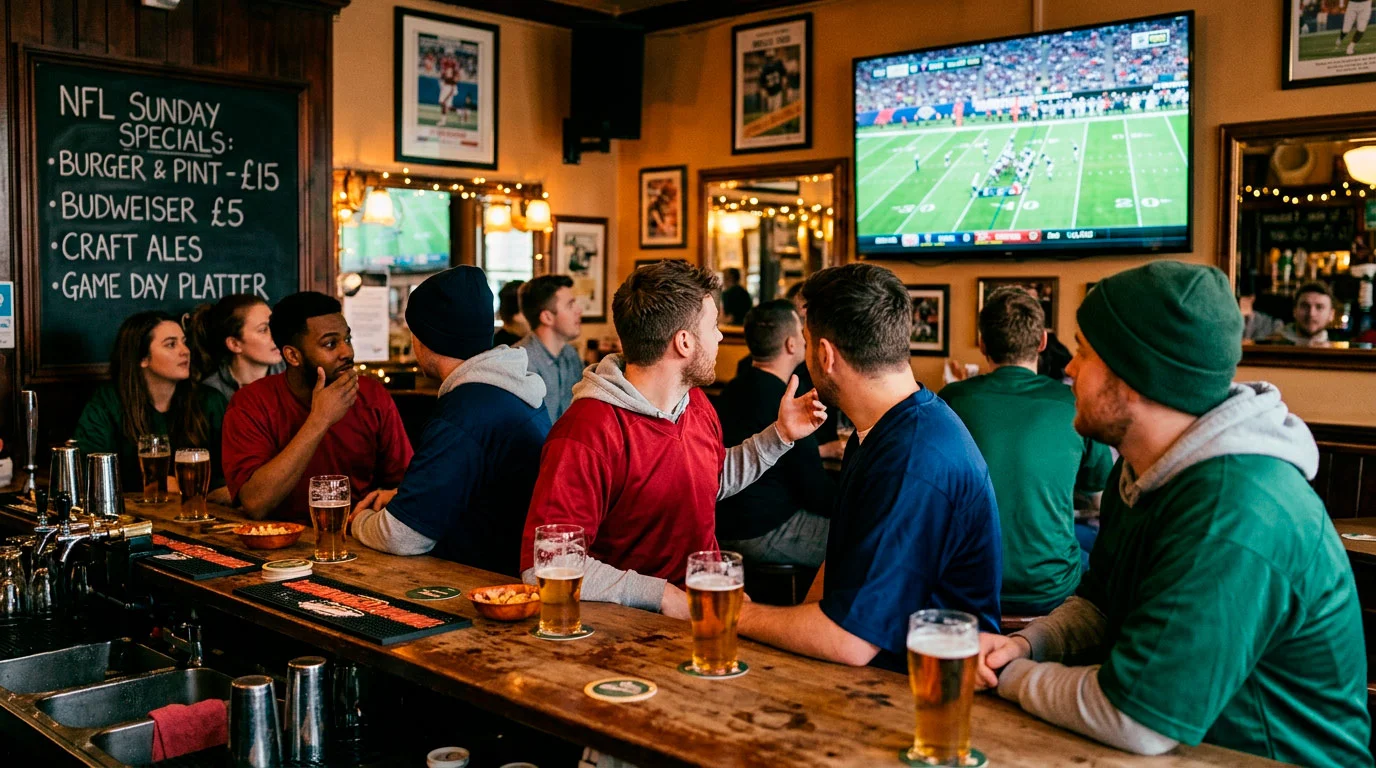
The UK's relationship with the NFL is no longer just about watching highlights on Monday morning. More than 6 million viewers tuned into the London Games in 2025 across TV and streaming platforms, and each of those games generated a measurable spike in betting activity at UK sportsbooks. The NFL has gone from a curiosity broadcast on late-night satellite channels to a mainstream sporting product with a dedicated, data-literate audience that knows what a point spread means and expects competitive odds from their bookmaker.
Super Bowl LVIII set a UK viewing record with a peak audience of 1.73 million, and the under-35 demographic surged 91% year-on-year. That youth wave is translating directly into betting activity — younger fans are the fastest-growing segment of the UK NFL wagering market.
What makes this market distinctive is its regulatory maturity. The UK Gambling Commission oversees every licensed operator, and punters benefit from protections that simply do not exist in many US states. That framework — combined with a fanbase that skews younger and more digitally native than the UK betting average — creates a market where NFL wagering is not just growing but evolving. The types of bets UK punters place on NFL games, the platforms they use, and the promotions they expect are all shifting. Understanding those shifts is the foundation of everything that follows in this guide.
How NFL Betting Works for UK Punters
The single biggest adjustment I had to make when I moved from casual NFL viewing to serious wagering was unlearning the assumption that betting on American football works like betting on Premier League matches. It does not. The market structure, the odds formats, and the sheer variety of available wagers are different enough that a seasoned football bettor can feel like a complete novice the first time they open an NFL coupon.
NFL betting revolves around three pillars: the odds format you read, the core market types you choose from, and the advanced constructions — parlays, props, futures — that let you build more complex positions. I will break each one down in the sections below, but here is the overarching principle: the NFL is a low-frequency, high-attention sport. There are only 272 regular-season games spread across 18 weeks, compared to 380 in the Premier League or 2,430 in MLB. Every game carries weight, every stat line gets scrutinised, and the betting markets reflect that intensity.
In-play wagering now accounts for 62.35% of all online sports betting revenue globally, and the NFL is a major driver of that figure. If you plan to bet on NFL games from the UK, understanding live markets is not optional — it is where the majority of the action happens.
Handle — the total amount of money wagered on a given event or across a market. When I say the NFL generated a billion handle in the 2025 US season, that is the sum of every dollar staked, not the profit bookmakers made from it.
The sections that follow will take you through odds formats, core bet types, and advanced markets in sequence. Each builds on the previous one, so if you are new to NFL wagering, I recommend reading them in order rather than skipping ahead.
Fractional, Decimal, and American: Reading NFL Odds
If you have ever stared at a line reading "-150" and felt your brain short-circuit, you are not alone. American odds are the default in NFL coverage worldwide, but UK sportsbooks typically display fractional or decimal odds. The good news: all three formats express exactly the same probability. The bad news: switching between them mid-research can trip you up if you are not fluent in the conversions.
The same implied probability expressed three ways:
Fractional: 4/6 | Decimal: 1.67 | American: -150
All three represent a 60% implied probability. A £10 stake returns £16.67 total (£6.67 profit) regardless of which format your sportsbook displays.
Fractional odds are what most UK punters grew up with. A price of 4/1 means you win £4 for every £1 staked, plus your stake back. Decimal odds roll the stake into the return: 5.00 means a £10 bet returns £50 total. American odds split into positive and negative numbers — a positive figure like +200 tells you the profit on a £100 stake (£200), while a negative figure like -150 tells you how much you need to stake to win £100 (£150).
The conversion formulas are straightforward once you have done them a few times. To move from American to decimal: for positive odds, divide by 100 and add 1 (so +200 becomes 3.00). For negative odds, divide 100 by the absolute value and add 1 (so -150 becomes 1.67). To get fractional from decimal, subtract 1 and express as a fraction — 3.00 becomes 2/1.
UK Default: Fractional Odds
Familiar to British punters. Easy to calculate profit at a glance. Standard across high-street bookmakers and most UK-facing apps. Best for quick mental arithmetic on single bets.
US Default: American Odds
Used in every NFL broadcast, podcast, and US analytics site. Essential for consuming American NFL content. The positive/negative split can confuse newcomers, but it reveals the favourite and underdog at a glance.
My recommendation: set your sportsbook to decimal odds for calculation ease, but learn to read American odds fluently. You will encounter them in every NFL preview, injury report, and odds movement tracker you follow. Most UK betting apps let you switch format in the settings menu with one tap, so there is no reason to limit yourself to a single system.
Core Bet Types: Spread, Moneyline, Totals
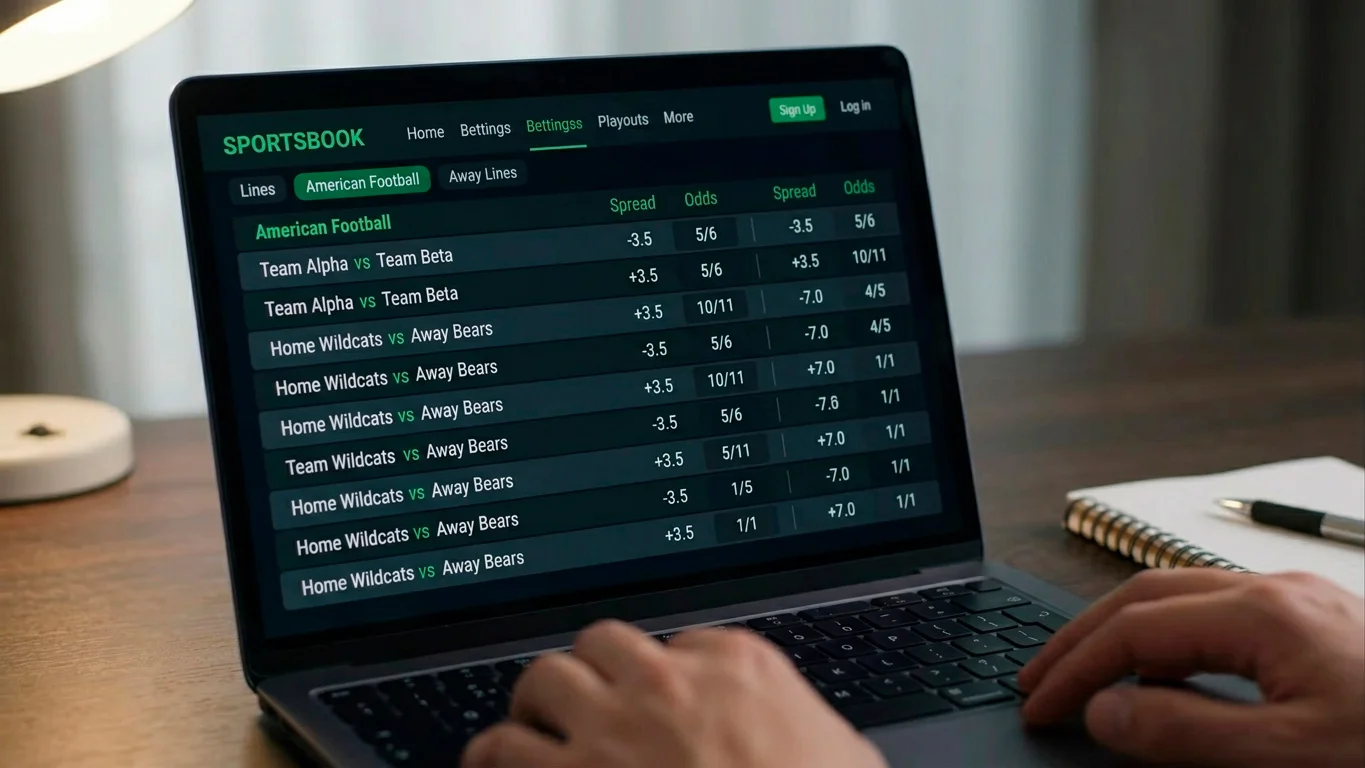
Three markets account for the vast majority of NFL betting volume worldwide, and they are the ones you need to understand before touching anything else: the point spread, the moneyline, and the total (over/under). Every other NFL market is either a variation of these three or a combination of them.
Point Spread — a handicap applied to the favoured team. If the Kansas City Chiefs are listed at -3.5, they must win by 4 or more points for a spread bet on them to pay out. The opposing team, listed at +3.5, can lose by up to 3 points and still "cover" the spread. The spread is the most popular NFL betting market in both the US and the UK.
The spread exists to level the playing field. Without it, betting on heavy favourites would offer terrible value and betting on underdogs would be pure charity. The handicap forces the bookmaker's odds toward even money on both sides, which is where the margin (the "vig" or "juice") lives. For a deeper look at how spreads are set, how key numbers like 3 and 7 shape the market, and strategies for NFL spread betting, I have written a dedicated breakdown.
Moneyline — a straight-up bet on which team wins the game, with no spread involved. The odds reflect each team's perceived probability of winning. Favourites carry shorter odds (lower payouts), underdogs carry longer odds (higher payouts). In the UK, this is sometimes listed as "match result" or "to win match".
Moneyline betting is the simplest NFL wager: pick the winner, collect if you are right. The trade-off is that heavy favourites offer slim returns. Backing a team at 1/5 (decimal 1.20) to win by any margin ties up capital for minimal profit. Moneyline bets become more interesting in games where the spread is tight — say, 1 to 3 points — because a small edge in prediction translates to meaningful value on the odds.
Total (Over/Under) — a bet on whether the combined score of both teams will be over or under a number set by the bookmaker. A typical NFL total might sit around 45.5 points. If you bet the over and the final score is 27-21 (48 total), you win. If it is 17-13 (30 total), you lose.
Totals betting lets you have a view on a game without picking a winner. It is particularly useful in matchups where you have strong opinions about offensive or defensive quality but cannot separate the two teams on the result. Weather conditions — wind, rain, extreme cold — can dramatically affect scoring and create value on unders.
These three markets form the backbone of every NFL betting slip. Master them before branching into more complex territory. Each one has its own rhythm: spreads reward discipline and knowledge of key numbers, moneylines reward conviction, and totals reward understanding of matchup dynamics and game environment.
Parlays, Props, Futures, and Bet Builders
Once you are comfortable with spreads, moneylines, and totals, the NFL opens up into a world of multi-leg and proposition markets that can feel overwhelming at first. The four you will encounter most often are parlays, player props, futures, and bet builders. Each carries higher potential returns — and higher risk — than a single-market wager.
Parlay (Accumulator) — a single bet that combines two or more selections. All legs must win for the bet to pay out. UK bookmakers call these accumulators or "accas". The appeal is obvious: a four-leg parlay at even odds on each leg pays 15/1 instead of the 1/1 you would get on each individually. The catch is equally obvious — one losing leg kills the entire ticket.
Player Prop — a bet on an individual player's statistical performance rather than the game outcome. Will the quarterback throw for over 275.5 yards? Will the running back score a touchdown? Props have exploded in popularity because they let you bet on the aspects of the game you follow most closely.
Futures — long-term bets placed well in advance of the outcome. Super Bowl winner, conference champion, MVP award, regular-season win totals. Futures lock up your capital for weeks or months, but they offer the largest potential payouts in NFL betting. The best value tends to appear in the off-season, before the market fully prices in roster moves and draft picks.
Bet Builder (Same Game Multi) — a tool that lets you combine multiple selections from a single game into one wager. You might combine a team to win, a player to score a touchdown, and the total to go over in one ticket. UK sportsbooks have invested heavily in bet builder technology, and it has become one of the most promoted features for NFL wagering.
A word of caution from someone who has seen punters blow through bankrolls chasing parlay payouts: the bookmaker's margin compounds with every leg you add. A four-leg acca does not just carry four times the risk of a single bet — the margin stacks multiplicatively. Use these markets with discipline, not as lottery tickets. The promotions and bonus offers that UK sportsbooks attach to accumulators — acca insurance, acca boosts — are designed to encourage multi-leg betting precisely because it is so profitable for the operator.
What to Look for in a UK NFL Sportsbook
I changed my primary NFL sportsbook three times before I found one that actually suited the way I bet. The first had great odds but terrible in-play latency. The second had a brilliant app but limited NFL prop markets. The third locked me out of a cash-out mid-game because of a "technical issue" that conveniently coincided with a momentum shift. Choosing the right platform is not about finding the "best" bookmaker in some abstract ranking — it is about matching your betting style to the features that matter for NFL wagering specifically.
The UK market currently has around 13.5 million active online betting accounts per month, spread across dozens of licensed operators. That is a lot of choice, and it can be paralysing. Rather than ranking operators — which changes with every promotional cycle anyway — I want to give you a checklist of features to evaluate for yourself.
NFL Sportsbook Evaluation Checklist
- UKGC licence displayed and verifiable on the Gambling Commission's public register
- NFL-specific market depth: spread, moneyline, totals, player props, game props, futures, and bet builder all available for regular-season games, not just the Super Bowl
- In-play betting with sub-10-second odds refresh during live NFL games
- Cash-out functionality available on NFL singles and accumulators, including partial cash-out
- Odds format toggle: fractional, decimal, and American switchable in-app
- NFL push notifications for odds movements, injury reports, and kickoff reminders
- Responsible gambling tools: deposit limits, session timers, reality checks, and self-exclusion accessible within two taps
The UK Gambling Commission's total industry gross gaming yield — excluding lotteries — reached £11.5 billion in the year to March 2024, a 5.7% increase year-on-year. That growth means operators are competing hard for your custom, which is good news for bettors who know what to look for. Michael Dugher, CEO of the Betting and Gaming Council, has pointed out that 22.5 million people in the UK enjoy a regular bet — a reminder that this is a mainstream activity, not a fringe pursuit, and the platforms serving it should meet mainstream standards of usability and transparency.
Do not evaluate a sportsbook based solely on its welcome offer. A £30 free bet means nothing if the platform lacks NFL prop markets, has slow in-play updates, or buries its responsible gambling tools three menus deep. Judge the product first, the promotion second.
One feature I always test before committing: open the sportsbook's mobile app during a live NFL game and see how it performs under load. Sunday afternoons during the NFL season — roughly 6pm to 11pm UK time — are peak traffic. An app that stutters, lags on cash-out requests, or fails to load prop markets during a live game is not fit for purpose, no matter how generous its sign-up bonus appears on paper.
UKGC Regulation and the 2026 Tax Overhaul
Regulation is not the section most punters want to read, but it is the one that will affect your NFL betting experience more than any other in 2026. I have spent twelve years watching the UK gambling landscape evolve, and the current tax overhaul represents the most significant structural shift since the Gambling Act 2005. If you ignore it, you will not understand why odds tighten, bonuses shrink, or operators exit the market in the months ahead.
The UK Gambling Commission licenses and regulates every operator that offers NFL betting to UK residents. That licence is non-negotiable: any sportsbook without one is operating illegally, and your money has no regulatory protection if something goes wrong. The UKGC framework covers fair odds, data protection, anti-money-laundering checks, and — increasingly — responsible gambling enforcement.
Baroness Twycross, the UK's Minister for Gambling, set the tone for the current regulatory era when she stated: "I want to work with you to see a safer, more responsible gambling industry. I know that the vast majority of people who gamble do so without experiencing harm, but it is in all our interests that we do better for those customers who could be vulnerable to gambling harm." That principle now drives policy.
But the headline story of 2026 is not player protection — it is taxation. The numbers are stark.
Remote Gaming Duty
Rising from 21% to 40% from 1 April 2026, nearly doubling the tax on online casino operators
General Betting Duty (Remote)
Increasing from 15% to 25% for remote betting, effective from April 2027 — sports betting operators face a two-thirds increase
Expected Tax Revenue
The government projects £5 billion in gambling tax receipts for 2026-27, a 24.8% jump from the previous year
The Remote Gaming Duty hike hits online casino products first, but the General Betting Duty increase coming in 2027 directly targets sports betting — including NFL wagering. Parry Jackson, a partner and head of the gaming sector at accountancy firm Price Bailey, captured the industry's reaction with characteristic understatement: "This remote gaming duty hike is so steep, it feels like the odds have suddenly shifted against the house."
What does this mean for you as a punter? Operators absorb tax increases through three mechanisms: widening their margins (which means worse odds for you), reducing promotional spend (fewer and smaller bonuses), or exiting the market entirely (less competition, which also means worse odds). The 2026-2027 tax changes will likely trigger all three to varying degrees. I have already seen early signs — welcome offers that were £30 free bets a year ago are now £20 at several operators, and some have quietly removed NFL-specific promotions from their seasonal calendars.
None of this makes NFL betting in the UK a bad proposition. The regulatory framework still protects punters better than almost any other jurisdiction in the world, and the market remains competitive enough to deliver fair odds. But the era of lavish promotions and razor-thin margins is closing. The operators that survive the tax squeeze will be the ones with scale, efficiency, and genuine product quality — and as a bettor, you should be choosing those operators now rather than chasing the biggest welcome bonus on a platform that may not be here in 2028.
London Games and International Expansion: What It Means for Odds
I was at Tottenham Hotspur Stadium for a London Game in 2023, surrounded by 62,000 fans in jerseys from 30 different teams, and the energy was indistinguishable from anything I have felt at an NFL stadium in the US. The difference? Kickoff was at 2:30pm local time, I could bet on my phone without VPN gymnastics, and the bookmakers had priced the game with UK punters specifically in mind. London Games are not novelty fixtures any more. They are a permanent, expanding part of the NFL calendar — and they carry unique implications for betting markets.
The 2026 season features a record 9 international games across 4 continents and 7 countries, with 3 of those games in London. Peter O'Reilly, the NFL's EVP for Club Business, Major Events and International, described the scale of it directly: "The 2026 NFL season will feature our most expansive and ambitious international slate yet, with regular-season games spanning Melbourne, Rio de Janeiro, London, Paris, Madrid, Munich and Mexico City." By the end of 2026, the NFL will have staged 45 regular-season games in the UK since the International Series began in 2007.
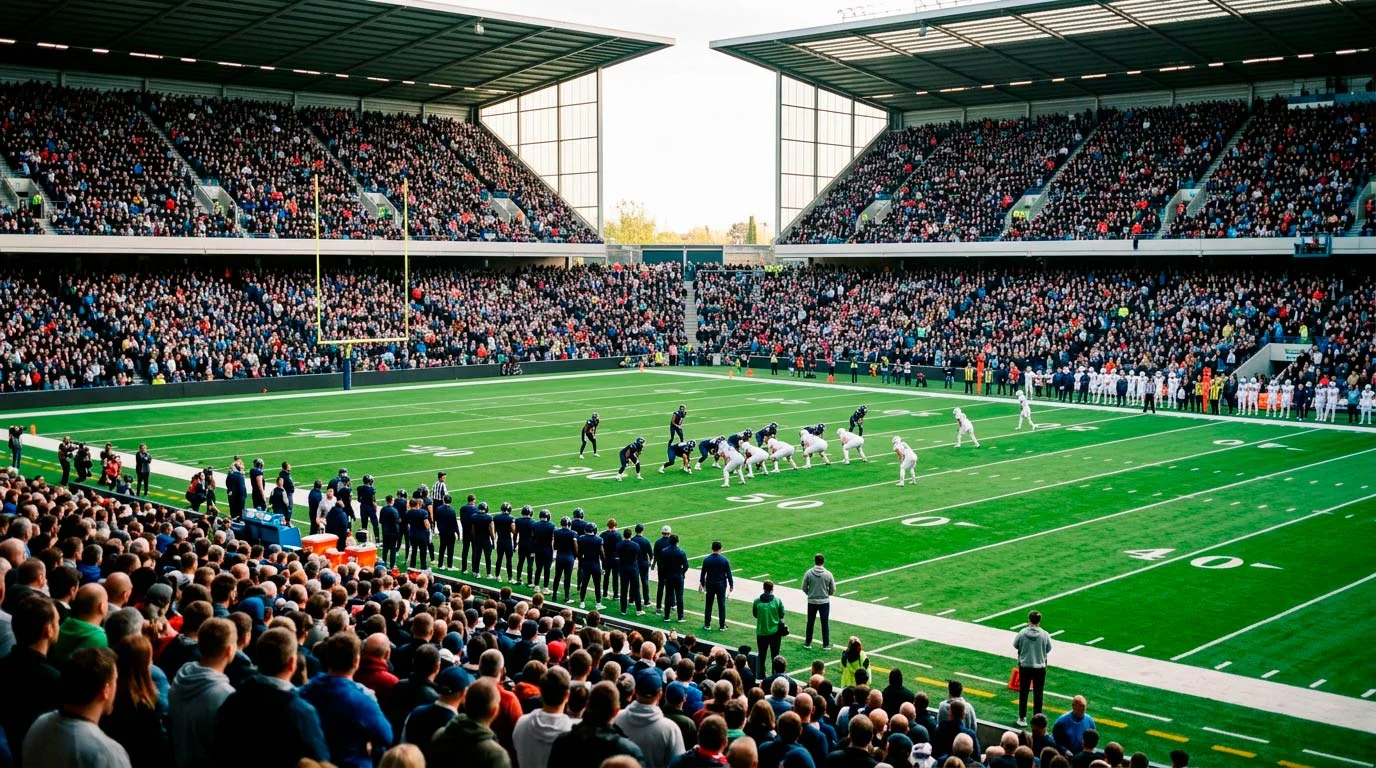
More than 6 million viewers watched the London Games in 2025 across TV and online platforms. That audience figure rivals many Premier League matchday broadcasts — and it drives a corresponding spike in betting volume at UK sportsbooks every time a game is played on British soil.
From a betting perspective, London Games create specific market dynamics that do not exist in regular US-hosted fixtures. The "home" team designation is largely meaningless — neither side has a genuine home-field advantage. Travel fatigue affects both teams, but the one designated as "away" often arrives later and has less time to adjust. Weather conditions at outdoor London venues differ from most NFL stadiums. And the earlier kickoff time — typically 2:30pm or 6pm UK time rather than the usual 6pm to 1:15am window for US games — means the betting market has different liquidity patterns. Early-window London Games often see sharper opening odds because professional bettors are more active during European business hours.
The expansion of international games also creates futures value. Teams scheduled for London Games face a unique competitive challenge: a transatlantic trip mid-season, a neutral venue, and a disrupted preparation week. Sharp bettors factor London Game assignments into season win total assessments and divisional futures. If your team is making two international trips in a single season — a possibility that grows more likely as the schedule expands — that is a tangible competitive factor worth pricing into your long-term positions.
UK vs US: How NFL Betting Differs Across the Atlantic
When I speak at industry events, someone inevitably asks whether UK punters have it better or worse than their American counterparts. The answer depends entirely on what you value. The US market generated a record .96 billion in sports betting revenue on a handle of 6.94 billion in 2025 — a staggering scale that dwarfs the UK. But scale does not equal quality of experience, and the two systems differ in ways that matter to the person placing the bet.
UK: National Regulation
One licence from the UKGC covers the entire country. Every operator follows the same rules on advertising, player protection, and dispute resolution. Punters pay zero tax on winnings — the operator absorbs the duty. Fractional and decimal odds are standard. Credit card gambling is banned. Self-exclusion through GamStop applies across all licensed operators simultaneously.
US: State-by-State Regulation
Each state sets its own rules. Legal sports betting is available in 38 states plus Washington DC, but market access, operator availability, and promotional rules vary wildly. Punters in some states face taxes on winnings. American odds are universal. Operator fragmentation means bonus shopping is easier but consumer protection is inconsistent.
The tax difference is the single most impactful distinction for individual bettors. In the UK, you keep every penny of your NFL winnings — the Gambling Commission does not tax the punter. In the US, federal tax applies to gambling winnings, and many states add their own layer on top. An American bettor who wins ,000 on a Super Bowl wager could owe ,400 or more in combined federal and state taxes before spending a cent. A UK bettor who wins the equivalent amount keeps it all.
Market depth tilts toward the US. American sportsbooks routinely offer 300+ markets per NFL game — alternate spreads at every half-point, individual quarter totals, drive-level props, team-specific series bets. UK sportsbooks typically offer 80 to 150 markets per game, which is still comprehensive but noticeably thinner at the edges. Where UK operators excel is in accumulator and bet builder functionality, which has been refined for the British market over decades of football (soccer) betting and translates well to NFL multi-leg construction.
The NFL itself generates around billion in legal wagers across US sportsbooks in a single season — a number that reflects both the sport's popularity and the country's population advantage. The UK's NFL handle is a fraction of that figure, but the per-capita engagement rate among UK NFL fans who bet is competitive with American markets. The growth trajectory in the UK is steeper, starting from a lower base, and the regulatory stability of a single national framework gives UK punters a consistency of experience that state-by-state American bettors simply do not have.
Staying in Control: Tools and Resources for UK Bettors
I lost more than I should have during my second NFL season of betting. Not because my analysis was wrong — it was — but because I had no structure around how much I was staking, how often I was topping up, or when to step away. The tools that could have helped me were available on every platform I used. I just did not activate them. That is the uncomfortable truth about responsible gambling: the infrastructure exists, but it only works if you use it.
The UK's betting demographics reveal something that matters here: 15% of men and 4% of women in the UK bet on sports, and the gender gap is even wider in NFL-specific markets. Across all demographics, the overwhelming majority of people who gamble do so without experiencing harm. But "the majority are fine" is cold comfort if you are in the minority, and the NFL's combination of emotional investment, weekly rhythm, and late-night UK kickoff times creates specific pressure points that are worth acknowledging openly.
Every UKGC-licensed sportsbook is required to offer deposit limits, session time reminders, cooling-off periods, and self-exclusion. These are not buried features — regulators require them to be accessible and functional. If your operator makes them hard to find, that is a red flag about the platform, not a reflection of your needs.
Do
- Set a weekly deposit limit before the NFL season starts and review it monthly
- Use session time reminders — NFL Sundays can run from 6pm to past midnight UK time, and it is easy to lose track
- Keep a simple record of every NFL bet you place: stake, market, result. Seeing the numbers on paper changes your perspective.
- Take advantage of cooling-off periods after a losing week rather than chasing losses into Monday Night Football
- Know that GamStop self-exclusion covers all UKGC-licensed operators at once — it is a comprehensive tool, not a single-site block
Don't
- Chase losses by doubling stakes on late-window games because the early results went against you
- Treat NFL parlays as low-cost entertainment — the "it's only £5" mindset adds up faster than most people track
- Bet on NFL games you have not researched simply because the market is open and the app sends a push notification
- Ignore signs that your betting is affecting your mood, sleep, or finances — these are signals, not weaknesses
- Assume that winning streaks will continue. Variance in NFL betting is real and persistent.
If you feel that your gambling is becoming difficult to control, the National Gambling Helpline (0808 8020 133) is free, confidential, and available 24 hours a day. GamCare provides counselling, and GamStop allows you to exclude yourself from all UK-licensed gambling sites for a period of your choosing. These services exist because the industry recognises that some people need them, and using them is a sign of good judgment, not failure.
Placing Your First NFL Bet: A Step-by-Step Walkthrough
Theory is useful. Practice is where the money goes. This section walks you through placing an actual NFL bet at a UK sportsbook, from account creation to settlement. I have watched enough people freeze at the "confirm bet" screen to know that the gap between understanding a market and executing a wager is wider than it looks.
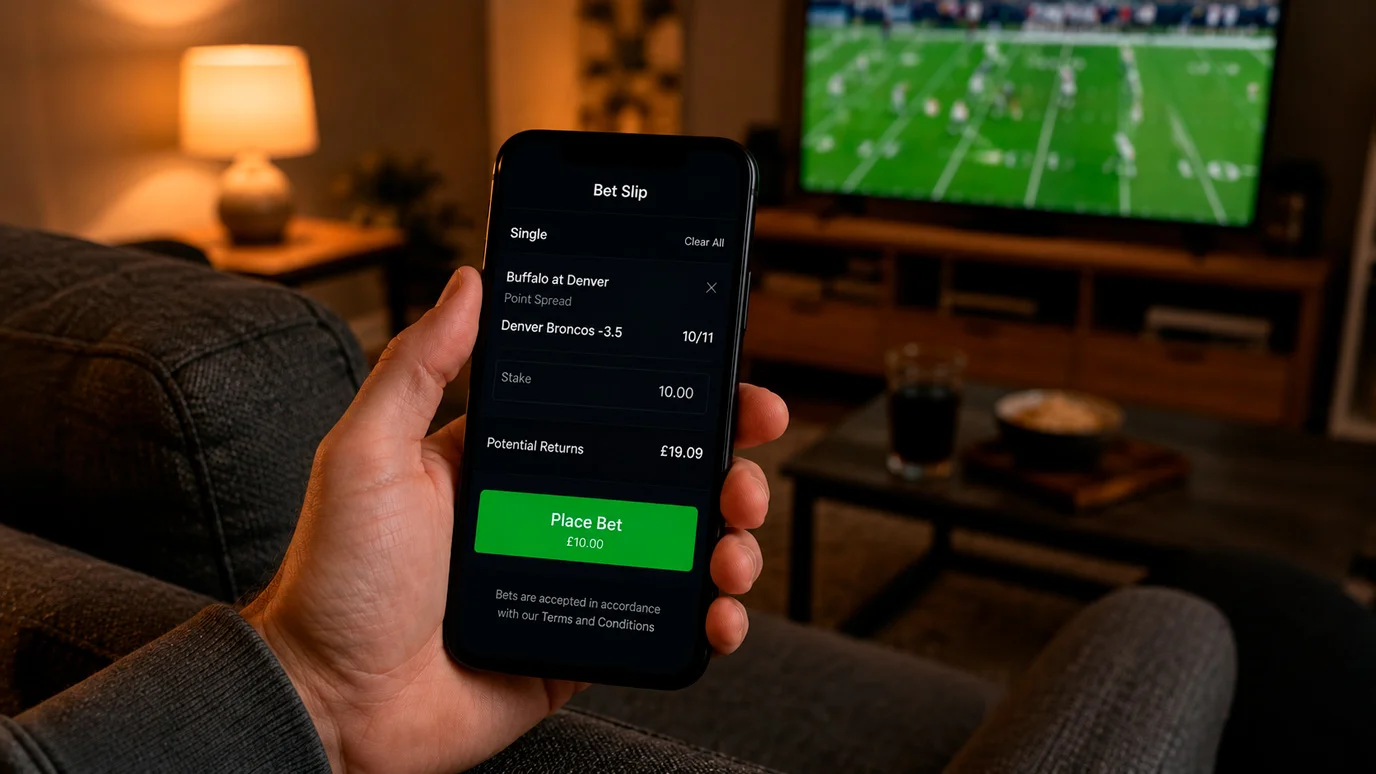
A key context point: 95% of online gambling in the UK happens from home, and 76% of bettors aged 18-24 use mobile devices as their primary platform. If you are placing your first NFL bet, chances are you will do it on your phone, probably from your sofa, on a Sunday evening. Here is how to make that process smooth.
Before You Place Your First NFL Bet
- Choose a UKGC-licensed sportsbook with NFL-specific markets (use the evaluation checklist from the previous section)
- Complete the registration process — you will need proof of identity and address for KYC (Know Your Customer) verification
- Set your deposit limit before funding your account, not after
- Switch your odds format to your preferred display (fractional, decimal, or American) in the app settings
- Navigate to "American Football" or "NFL" in the sports menu and familiarise yourself with the layout before selecting any market
- Start with a single-market bet — spread, moneyline, or total — rather than a multi-leg parlay
The mechanics of placing the bet itself are straightforward. Select the NFL game you want to bet on. Choose your market — let's say the point spread. Tap the selection to add it to your bet slip. Enter your stake. The potential return will calculate automatically. Review the details: team, market, odds, stake, potential payout. If everything matches your intention, confirm the bet.
Settlement depends on the market type. Spread, moneyline, and total bets settle within minutes of the game ending. Futures bets — like Super Bowl winner or MVP — settle at the conclusion of the relevant event, which could be months after you placed the wager. Player props typically settle at the end of the player's participation in the game.
One piece of advice I give to every new NFL bettor: your first bet should be small enough that losing it teaches you something rather than stresses you. A £5 moneyline bet on a game you have genuinely researched is worth more as a learning experience than a £50 four-leg acca cobbled together from gut feelings five minutes before kickoff. The goal of your first bet is not to win — it is to understand the process from selection to settlement, so that every subsequent bet is placed with confidence and clarity.
If you want to claim a welcome offer or free bet on your first wager, read the terms carefully. Minimum odds requirements, wagering conditions on free bet winnings, and market restrictions vary between operators. The biggest promotional pushes tend to coincide with the start of the regular season in September and the build-up to the Super Bowl in February, so timing your account opening can make a difference.
With your first bet placed and settled, the foundation is set. The questions below cover the specifics that new and experienced NFL bettors in the UK ask most often.
NFL Betting in the UK: Common Questions
Is it legal to bet on the NFL in the UK?
Yes. NFL betting is fully legal in the United Kingdom through any sportsbook licensed by the UK Gambling Commission. The UKGC regulates all remote gambling operators serving UK customers, and NFL markets are a standard offering at licensed bookmakers. There are no restrictions on which NFL games you can bet on, including regular-season fixtures, playoffs, and the Super Bowl. The critical requirement is that you use a UKGC-licensed operator — unlicensed offshore sites offer no regulatory protection, no guaranteed payout, and no access to dispute resolution through the Gambling Commission.
What types of bets can I place on NFL games?
UK sportsbooks offer a wide range of NFL markets. The three core bet types are the point spread (backing a team to win by more than a set handicap or to lose by fewer points than the handicap), the moneyline (picking the outright winner), and the total or over/under (betting on whether the combined score exceeds or falls short of a set number). Beyond those, you can access player props (individual statistics like passing yards or touchdowns), game props (team-level events like total sacks or first scoring play), futures (Super Bowl winner, MVP, season win totals), parlays or accumulators (multi-leg bets), and bet builders that combine selections within a single game. The depth of available markets varies between operators, with some offering 100+ options per game and others covering only the core markets.
How do NFL odds work for UK punters?
NFL odds express the implied probability of an outcome and determine how much you win relative to your stake. UK sportsbooks typically display odds in fractional format (e.g. 5/2) or decimal format (e.g. 3.50), though American odds (+250 or -150) are the standard in US-originated NFL content. All three formats represent the same underlying probability — they are just different ways of expressing it. Most UK betting apps let you switch between formats in the settings. Fractional odds show profit relative to stake (5/2 means £5 profit per £2 staked). Decimal odds show total return including stake (3.50 means £3.50 returned per £1 staked). Learning to read American odds alongside your preferred UK format is valuable because injury reports, podcasts, and analytics sites almost always use the American system.
Can I bet on NFL games live (in-play)?
Yes, and in-play NFL betting has become the dominant mode of wagering. Live betting accounts for over 62% of online sports betting revenue globally, and the NFL is a major contributor to that figure. UK sportsbooks offer in-play markets throughout NFL games, including updated spreads, moneylines, totals, and selected props. Odds adjust in real time based on the score, game clock, field position, and momentum. Cash-out options are typically available during live play, allowing you to lock in a profit or cut a loss before the game ends. The main consideration for UK punters is timing: most NFL games kick off between 6pm and 1:15am UK time, with in-play markets active throughout.
What time do NFL games kick off in the UK?
NFL kickoff times in the UK depend on the game window. The early Sunday window is 6pm BST/GMT, with the late Sunday window at 9:05pm or 9:25pm. Sunday Night Football kicks off at 1:20am Monday morning UK time. Monday Night Football follows a similar late pattern at 1:15am Tuesday. Thursday Night Football starts at 1:20am Friday. London Games, when scheduled, typically kick off at 2:30pm or 6pm UK time, making them the most accessible fixtures for UK-based punters who prefer not to bet into the early hours. During the 2026 season, three London Games are confirmed, plus international fixtures in other European cities with UK-friendly kickoff times.
How do I claim NFL free bet offers?
Free bet offers at UK sportsbooks typically follow a "bet and get" structure: deposit a minimum amount, place a qualifying bet at minimum odds, and receive a free bet credit once the qualifying bet settles. The free bet itself usually cannot be withdrawn as cash — only the winnings from using it are paid out, and often the original free bet stake is deducted from any returns. Key terms to check: minimum qualifying odds (commonly 1/2 or higher), time limits on using the free bet, and market restrictions (some offers exclude certain bet types). NFL-specific promotions tend to appear at the start of the season in September and around the Super Bowl in February. Read every term before opting in, and never choose a sportsbook based on the welcome offer alone.
Do UK tax changes in 2026 affect my NFL bets?
Not directly. UK punters do not pay tax on gambling winnings — that has not changed. The tax burden falls on the operator, not the bettor. However, the 2026-2027 tax increases — Remote Gaming Duty rising from 21% to 40% and General Betting Duty for remote operators climbing from 15% to 25% — will affect you indirectly. Operators absorb higher taxes by widening their margins (which means slightly worse odds), reducing promotional spend (smaller or fewer bonuses), or passing costs through in other ways. You will not see a line item on your bet slip labelled "tax", but the cumulative effect of the duty increases will likely mean marginally less generous odds and promotions across the UK market over the next 12-24 months.
