
NFL Betting Apps UK: Best Mobile Sportsbooks for 2026
 Available in US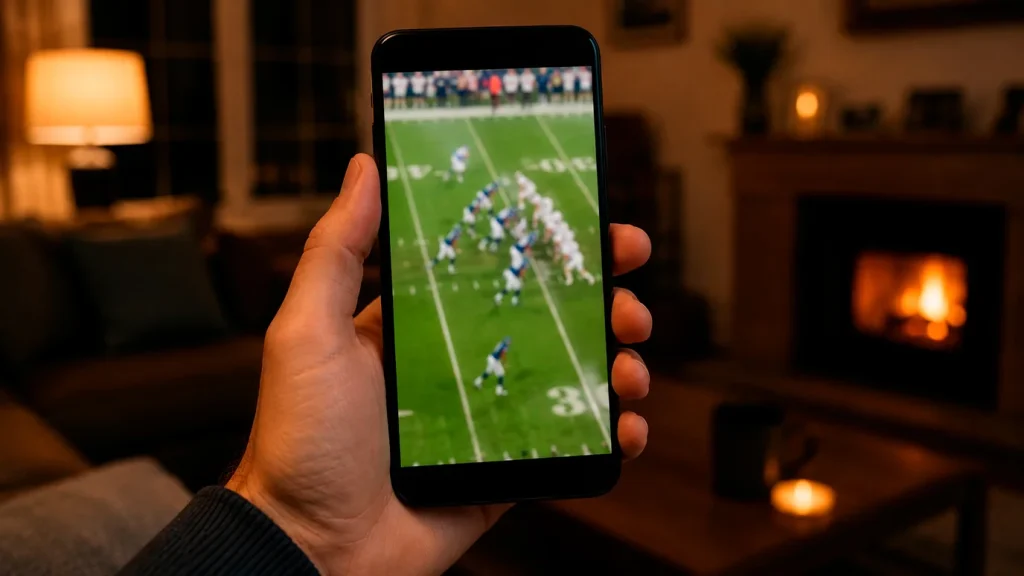
Last September I tried an experiment: I bet the entire opening week of the NFL season exclusively from my phone — research, line shopping, bet placement, and in-play wagers, all on mobile. No laptop, no desktop, no second screen. By Sunday night I had placed 11 bets across four different apps and not once did I feel limited by the interface. That is how far mobile sportsbooks have come for NFL betting in the UK. The apps are not a convenience any more; they are the primary platform.
The numbers confirm what my experiment suggested. Ninety-five percent of online gambling in the UK happens from home, and among 18-to-24-year-olds, 76 percent use mobile devices as their primary gambling tool. The high street bookmaker is fading — the number of betting shops in Britain has dropped to 5,931, a decline of nearly 23 percent from pre-pandemic levels — and the action has migrated almost entirely to apps. For NFL betting specifically, where games kick off in the evening and run past midnight UK time, the phone on your sofa is the natural interface.
But not all apps are equal, and the differences matter more than most punters realise. In-play speed, NFL-specific features, notification systems, and UKGC compliance vary meaningfully across operators. This piece evaluates what to look for, what to avoid, and how to get the most from your mobile NFL betting setup in 2026.
See also NFL betting payment methods supported by top apps.
Contents
Why Mobile Dominates NFL Betting in the UK
Three years ago, a senior product manager at a major UK sportsbook told me something that reframed how I think about betting apps. He said: “We do not build a website and then make a mobile version. We build the mobile experience and then decide what else goes on the desktop.” That is the reality of UK sports betting in 2026. The app is the product; everything else is supplementary.
The migration to mobile is driven by behaviour, not technology. NFL games in the UK run from 6pm to past midnight — hours when people are on the sofa, commuting home, or watching at a pub. The phone is already in their hand. Opening a betting app is a thumb-reach away from checking the score on a sports app or scrolling social media. The friction between “watching” and “betting” has been reduced to almost zero, and that frictionless experience is what sustains the roughly 290 million online bets placed on real events in the UK every month.
Michael Dugher, CEO of the Betting and Gaming Council, has pointed out that 22.5 million people in the UK enjoy a regular bet — a population larger than the combined metros of London, Manchester, and Birmingham. The vast majority of those bettors access the market through a mobile app. For NFL specifically, the mobile-first audience skews younger and more digitally native than the overall betting population, which means they expect app performance (speed, reliability, feature depth) to match what they experience on platforms like banking apps and streaming services.
The practical implication for you: evaluating an NFL betting app is not a trivial exercise. The app you choose determines the markets you can access, the speed at which you can act on in-play opportunities, and the tools available for managing your bankroll. Getting it right is a genuine competitive advantage. Getting it wrong means watching value windows close while your app buffers.
Evaluating an NFL Betting App: Features That Matter
I evaluate NFL betting apps on five criteria, and I weight them in a specific order that reflects how they affect the actual betting experience rather than how they look in a promotional screenshot.
First: in-play speed. This is the single most important performance metric for any NFL betting app. When a touchdown is scored and the live spread shifts, the app needs to reflect that change within seconds — not minutes. Delayed odds mean you are either betting on stale prices (which will be rejected) or watching opportunities vanish while the screen loads. Test this during a live game before committing significant money. Open the app, navigate to a live NFL market, and observe how quickly the odds update after a scoring play. If there is a noticeable lag compared to the broadcast, the app is not fit for in-play use.
Second: market depth for NFL. Not all sportsbooks treat American football equally. Some devote extensive trading resources to NFL, offering 150+ markets per game including player props, drive-result bets, and alternative spreads. Others treat the NFL as a secondary sport with 20 to 30 markets per game — adequate for a casual punt, but inadequate for a bettor who wants to trade specific angles. Check the NFL section during a regular-season Sunday, not during the Super Bowl, because Super Bowl coverage inflates every operator’s numbers.
Third: navigation and bet slip design. You should be able to move from the NFL lobby to a specific game to a specific market within three taps. The bet slip should clearly display the selection, the odds, and the potential return before you confirm. Any app that buries the NFL under “American Sports” or requires scrolling past dozens of football leagues to find the gridiron section is wasting your time — and in live betting, time is literally money.
Fourth: deposit and withdrawal speed. A banking section that processes deposits instantly and handles withdrawals within 24 hours is table stakes in 2026. If an app takes three to five days to process a withdrawal, that is a red flag — either the operator is sitting on your funds or their payment infrastructure is outdated. Both are problems.
Fifth: responsible gambling tools. Every UKGC-licensed app is required to offer deposit limits, loss limits, reality checks, and self-exclusion options. The question is how accessible these tools are. An app that buries the deposit limit setting behind four menu screens is technically compliant but practically discouraging. The best apps surface these controls prominently in the account settings and send proactive notifications when you approach a self-imposed limit. The total gross gambling yield for the UK’s remote sector — online casinos, betting, and bingo combined — reached 6.9 billion pounds in the year to March 2026, growing at nearly 7 percent annually. As that number rises, the quality of responsible gambling tools becomes more important, not less.
NFL-Specific App Features: Bet Builders, Alerts, and Stats
The feature that has changed my NFL betting workflow more than any other in the past three years is the bet builder. Also called “same game multi” or “request a bet” depending on the operator, this tool lets you combine multiple selections from a single game into one wager with a calculated combined price. On a Sunday evening, I might build a bet that combines a team to win, a quarterback to throw over 249.5 yards, and the total to go under 47.5 — all within the same game, all priced as a single bet.
The bet builder’s value for NFL is particularly high because American football generates enormous amounts of granular data. Player-level stats (passing yards, rushing attempts, receptions, tackles) are tracked with precision, and sportsbooks use this data to price individual legs within the builder. The challenge is that correlated selections — outcomes that are statistically linked — receive a pricing penalty. If you select a team to win and their quarterback to throw over 300 yards, those legs are positively correlated, and the combined price will be lower than if the selections were independent. Understanding correlation is the difference between building a smart bet and building an expensive one.
Push notifications are the second feature worth prioritising. The best NFL betting apps offer customisable alerts for odds changes on specific games, new market availability (such as prop lines dropping for Sunday’s games), and promotional offers tied to the NFL. If you are line shopping — comparing spreads across multiple apps to find the best number — a notification that tells you “Chiefs -6.5 is now available” saves you from manually cycling through four apps every hour.
In-app statistics and form guides are increasingly common but vary enormously in quality. Some apps embed basic team stats (record, points per game, yards per game) directly into the game page, which is useful as a quick reference before placing a bet. Others link out to third-party stats providers or offer nothing at all. In my experience, the in-app stats are never sufficient for serious analysis — you will always want a dedicated data source for NFL analytics — but having baseline numbers at a glance reduces the friction of moving between research and execution.
Cash out functionality, covered more thoroughly in the live betting context, is another app-level feature whose implementation varies. Some apps offer partial cash out (settling a portion of your stake while leaving the rest running), auto cash out (pre-setting a profit or loss threshold at which the app automatically settles your bet), and cash out on accumulators. Others offer basic full cash out only. If you bet NFL in-play regularly, the sophistication of the cash out tool matters more than you might expect.
iOS vs Android: Are There Differences for NFL Betting?
This is one of the questions I get asked most often, and the honest answer is: the differences are shrinking to near-zero. In 2020, there were meaningful gaps — iOS apps tended to be more polished, Android apps occasionally lagged behind in feature rollouts, and some operators released updates to the App Store before the Play Store. By 2026, the major UK sportsbooks have converged to near-identical experiences on both platforms.
There are a few residual differences worth noting. iOS enforces stricter background processing rules, which means some apps cannot refresh odds in the background as aggressively on iPhone as on Android. In practice, this means you might open an iPhone app after a 10-minute break and see slightly stale odds for a second before they update, while the Android version may have already refreshed. The difference is marginal and unlikely to affect your betting decisions unless you are operating on razor-thin in-play windows.
Android offers one practical advantage: sideloading. Some sportsbook apps are available as direct APK downloads from the operator’s website, bypassing the Play Store entirely. This is occasionally relevant when an operator has not yet published an Android app through Google’s official channel, but it carries a risk — sideloaded apps do not receive Google’s automated malware screening, so only download from the operator’s verified domain. On iOS, all apps must go through the App Store, which provides a baseline security filter.
Widget support has improved on both platforms. Several UK sportsbooks now offer home-screen widgets that display live scores, odds for pinned games, and quick links to specific markets. If you use an NFL widget during the Sunday evening window, you can monitor odds movement passively without opening the full app. This is a small convenience, but over a 17-week season it accumulates into meaningful time savings — and anything that reduces friction between information and action is worth adopting.
Security and UKGC Compliance in Betting Apps
Every sportsbook app operating legally in the UK must hold an active licence from the UK Gambling Commission. This is non-negotiable. The licence number should be visible in the app’s settings or “about” section, and you can verify it on the UKGC’s public register in under a minute. If the licence number is not displayed or does not match the UKGC register, do not deposit money. Full stop.
UKGC licensing imposes specific technical requirements on betting apps. Customer funds must be held in segregated accounts, separate from the operator’s own finances. This means that if the operator goes bust, your balance is protected from the company’s creditors. Identity verification (KYC) must be completed before you can withdraw funds — and increasingly, before you can deposit. The KYC process can be inconvenient (passport photo, proof of address), but it exists to prevent fraud, money laundering, and underage gambling. The total GGY of the UK gambling industry, excluding national lotteries, reached 11.5 billion pounds in the year to March 2026 — a market of that size attracts bad actors, and the regulatory framework is the primary defence.
Encryption is standard across all major apps — your data in transit and at rest should be protected by TLS 1.2 or higher, and your login should support biometric authentication (fingerprint or face recognition). Two-factor authentication (2FA) for account access and withdrawals is offered by some operators and should be enabled wherever available. The marginal inconvenience of a six-digit code at login is trivial compared to the cost of a compromised account.
One area where security intersects with user experience: session timeouts. Some apps log you out after a period of inactivity (typically 15 to 30 minutes), while others keep your session active indefinitely. An app that logs you out mid-game and requires a full re-login during a live betting window is a genuine usability problem. Check this before you need it — test how the app handles returning from a backgrounded state during a game — so you are not locked out at the worst possible moment.
Red Flags: When a Betting App Falls Short
I once downloaded an app that looked slick in screenshots but crashed three times during a single Thursday Night Football game. That taught me a lesson worth sharing: the polish of a marketing page tells you nothing about the experience under load. Here are the warning signs I have learned to watch for.
Delayed odds updates during live games are the single biggest red flag. If you are watching a turnover happen on screen and the app still shows the pre-turnover line ten seconds later, the platform cannot handle real-time data at the speed NFL in-play betting demands. A few seconds of delay is normal — every operator processes data through their trading engine before updating the interface — but anything beyond five seconds puts you at a disadvantage. You are either betting on stale prices or waiting for a refresh that never comes.
Restricted withdrawal options are another signal that something is off. A reputable UKGC-licensed app should let you withdraw to the same method you used to deposit, with processing times clearly stated in the terms. If an app offers fifteen deposit methods but only two withdrawal routes, or if withdrawals consistently take longer than the stated timeframe, treat that as a structural problem rather than a one-off glitch.
Poor customer support is less dramatic but equally telling. If you encounter an issue with a settled bet at half past midnight on a Sunday — prime NFL hours in the UK — and the only support option is an email form with a 48-hour response time, the operator has not built its infrastructure around your schedule. Live chat, available during NFL game windows, is the minimum standard for an app targeting American football bettors in the UK.
Finally, watch for apps that bury responsible gambling tools. UKGC regulations require operators to offer deposit limits, loss limits, session timers, and self-exclusion options. These should be accessible within two taps of the main screen, not buried six menus deep in a settings page. An operator that makes responsible gambling tools hard to find is one that does not take its regulatory obligations seriously — and if it cuts corners there, it cuts corners elsewhere.
See also nfl bet online for the complete NFL betting guide.
Your NFL Season Starts in Your Settings Menu
The app on your phone is the starting line, not the finish. What separates a productive NFL betting season from a frustrating one is not which operator you choose but how deliberately you use the tools available. Set your notifications, test your cash out settings during a preseason game, and know exactly how long your session stays active in the background. The 2026 NFL season brings nine international games across four continents — seven countries, three in London alone — and the UK audience keeps growing. Henry Hodgson, the NFL’s UK general manager, has pointed to the surge in younger fans driving that expansion. The apps will evolve with them. Make sure you evolve too.
