
NFL London Games Betting: Odds, Markets & Matchday Guide 2026
 Available in US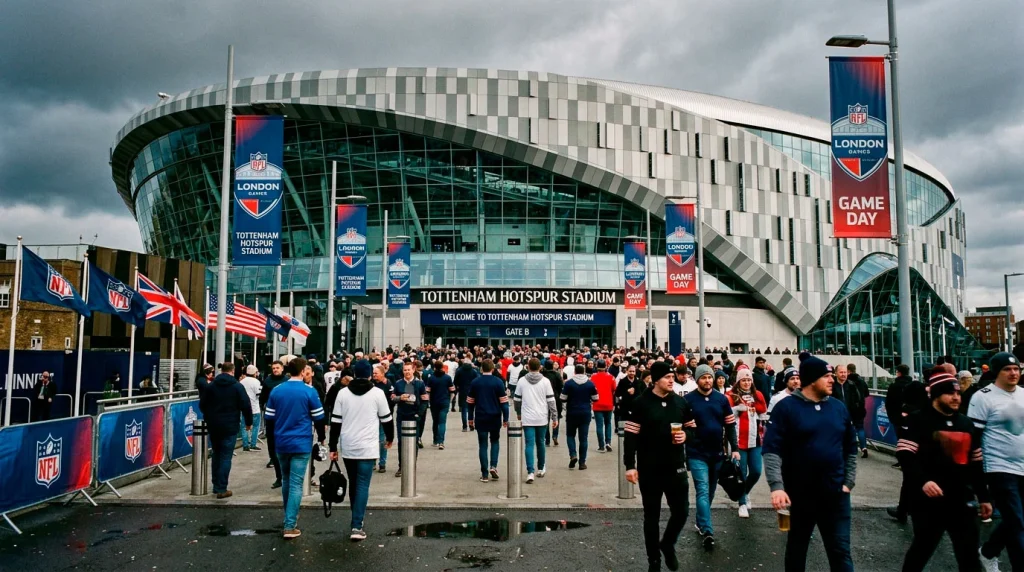
I was in the stands at Tottenham Hotspur Stadium for a London Games matchup in 2023, surrounded by 60,000 fans who had been waiting all year for live NFL action on home soil. The atmosphere was electric — part American tailgate, part Premier League matchday, part something entirely its own. And somewhere in the third quarter, as the designated “home” team punted for the sixth time, I realised I had the under locked in at a number the market had set as if the game were being played in a climate-controlled dome in Arizona. London Games are different. The betting should be too.
The 2026 NFL season features a record nine international regular-season games across four continents and seven countries. Three of those games will be played in London, continuing a tradition that began in 2007 and has now delivered 45 regular-season games to British soil. More than 6 million viewers tuned in to the 2026 London Games across TV and online platforms. The scale is no longer experimental — it is institutional. And for UK punters, these games represent the only NFL action where you can genuinely claim local knowledge as an edge.
See also Super Bowl betting as another marquee NFL event.
Contents
The 2026 London Games: Teams, Venues, and Dates
Specific team and date announcements for the 2026 London slate typically arrive in the spring, after the full NFL schedule is released. What we already know is the scope: three London games are confirmed, continuing the pattern of split hosting between Tottenham Hotspur Stadium and Wembley Stadium.
The NFL’s EVP for Club Business and International, Peter O’Reilly, described the 2026 international slate as “our most expansive and ambitious” yet — spanning Melbourne, Rio de Janeiro, London, Paris, Madrid, Munich, and Mexico City. London’s three games place it alongside only Mexico City as a multi-game host city, underscoring how central the UK market has become to the league’s global strategy.
By the time the 2026 London games kick off, the UK will have hosted 45 regular-season NFL games since the programme’s inception. That history creates a data set that bettors can mine: how do teams perform when they travel transatlantic? How do specific venues affect play style? How does the crowd — overwhelmingly UK-based, with different energy patterns than a US home crowd — influence the atmosphere?
The venue distinction matters for betting. Tottenham Hotspur Stadium has a purpose-built NFL pitch beneath its retractable football surface, producing a playing field that is closer to NFL standards than Wembley’s repurposed surface. Teams playing at Spurs tend to have slightly more consistent offensive production, though the sample is still small enough that this observation should be treated as a factor, not a rule.
How Transatlantic Travel Affects NFL Odds
Every conversation about London Games betting eventually arrives at the same question: does the travel hurt teams? The answer is more nuanced than most analysis acknowledges.
Both teams travel. That is the starting point that many bettors overlook. In a typical NFL game, the away team flies domestically — maybe a three-hour flight from the East Coast to the Midwest. In a London Game, both teams cross the Atlantic, which neutralises much of the standard travel disadvantage. The designated “home” team does not play in their own stadium, does not sleep in their own beds, and does not have their typical home-field crowd advantage. The designation is largely cosmetic for betting purposes.
Where travel does create an asymmetry is in schedule positioning. Teams that play a London Game in Week 5, for instance, often have their bye week scheduled immediately before or after the trip. The NFL makes an effort to accommodate the travel, but the combinations vary. A team coming off a bye before London is physically rested but may lack game rhythm. A team with a bye after London knows they can push through the fatigue and recover — which can produce higher-effort performances on the day. I track the bye-week positioning relative to the London Game for each team and treat it as a significant variable in my pre-match assessment.
Over 6 million viewers watched the 2026 London Games, which translates directly into betting volume at UK sportsbooks. These games typically generate higher-than-average in-play trading activity at UK books because the kick-off times — usually 2:30 PM or 6:00 PM local time — fall within peak UK betting hours, unlike the standard 6:00 PM Sunday window for regular US-scheduled games. That higher volume can mean tighter spreads and more efficient pricing, which is worth factoring into your value assessment.
Betting on NFL London Games: Markets and Timing
Henry Hodgson, the NFL UK General Manager, has spoken about ensuring that international games serve long-term fanbase growth, not just short-term spectacle. For bettors, that philosophy translates into games that are designed to showcase the sport — which typically means competitive matchups rather than lopsided ones. The NFL has historically avoided sending genuinely terrible teams to London, though there have been exceptions. The result is that London Games tend to have tighter spreads than the league average, which favours a different betting approach than a typical Week 8 mismatch.
I approach London Games with three adjustments to my standard process. First, I weight venue familiarity more heavily. Has either team played in London before? Teams with prior London experience — the Jacksonville Jaguars are the most obvious example, having played more London Games than any other franchise — tend to handle the logistics more smoothly. Coaching staff who have done it before know how to manage the travel schedule, practice timing, and player routines. First-time London teams face a steeper learning curve.
Second, I shift my focus toward unders and defensive metrics. London Games have historically produced slightly lower scoring than the league average. The reasons are debatable — jet lag, unfamiliar surface, crowd noise patterns — but the pattern is consistent enough across a multi-year sample to inform my totals analysis. When the market sets a total for a London Game that mirrors what the same matchup would produce in the US, I lean under.
Third, I look at the futures implications. A London Game win or loss can shift a team’s season trajectory — and futures prices — significantly. If I hold a season win total position on a team playing in London, I assess whether the London result could create a cash-out opportunity or a hedging position. The game’s placement in the schedule — early season versus mid-season — determines how much the futures line will move in response.
See also nfl bet online for the complete NFL betting guide.
The Home Advantage That Isn’t
UK punters sometimes ask whether the “home” designation in London Games carries real value. After tracking every London Game since the programme began, my answer is that it carries almost none. The designated home team does not benefit from the typical home-field factors — familiar surroundings, partisan crowd, no travel — because none of those factors apply. Both teams are guests.
The crowd at London Games is enthusiastic but eclectic. Unlike a game at Arrowhead Stadium where 76,000 fans are unified behind the Chiefs, a London crowd features fans of both teams plus a large contingent of neutral NFL enthusiasts who simply love the sport. The noise is genuine but rarely directional — it does not create the communication disruption that a true home crowd generates. If anything, the neutral crowd benefits the underdog by removing the hostile-environment factor that typically suppresses road-team performance.
For betting purposes, treat London Games as neutral-site contests. Ignore the home/away designation entirely. Analyse the matchup on talent, form, and schedule context — the same way you would assess a Super Bowl or a pre-season game at a neutral venue. The London factor is real, but it applies equally to both sides.
