
NFL Futures Betting UK: Season Wins, MVP & Conference Odds
 Available in US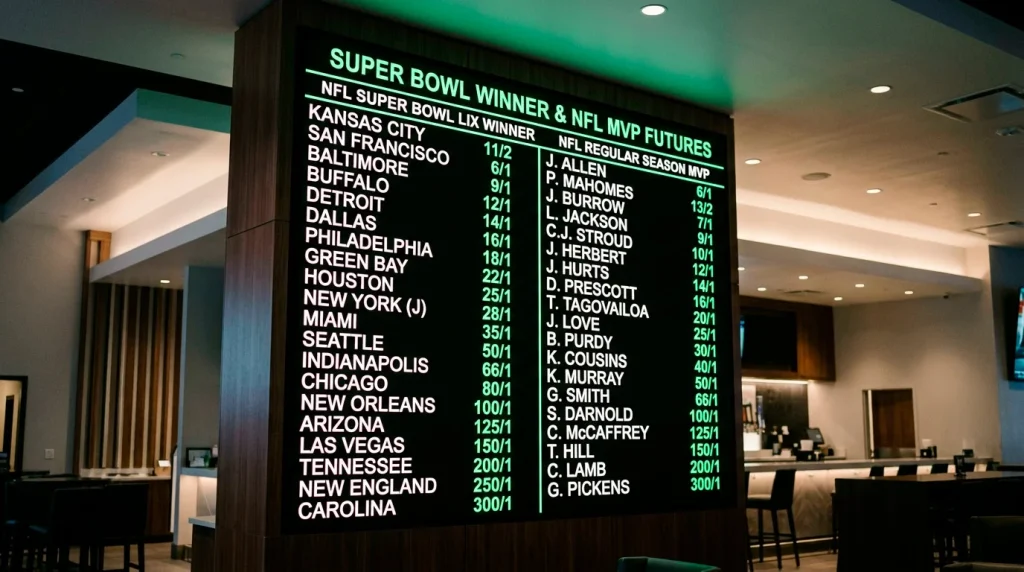
I placed a Super Bowl futures bet on the Cincinnati Bengals at 40/1 in July 2021. They reached the Super Bowl that February. The payout was real, but so was the five-month wait — and the dozen moments during the season when I questioned whether to cash out or hold. Futures betting is the NFL’s longest game, and it tests patience in ways that week-to-week wagering never does.
Futures markets ask you to predict outcomes that will not be settled for weeks or months. Super Bowl winner. Conference champion. Division winner. MVP. Season win totals. The odds are set months before the first snap and shift constantly as the season unfolds, driven by results, injuries, trades, and public sentiment. Americans wagered roughly $30 billion on NFL through legal sportsbooks during the 2026 season, and futures represent a growing share of that handle because they keep bettors engaged across the entire campaign.
See also NFL Draft betting for pre-season futures.
Contents
NFL Futures Markets: What You Can Bet On
The menu has expanded dramatically in the twelve years I have covered this space. A decade ago, UK sportsbooks offered Super Bowl winner, conference winners, and maybe a handful of division markets. Today, a comprehensive NFL futures book might list fifty or more long-term markets before the season even starts.
Super Bowl winner is the flagship. Every team is priced, and the range is vast — from pre-season favourites around 4/1 to bottom-tier teams at 200/1 or beyond. Conference winner markets (AFC and NFC) offer shorter odds because you only need your team to reach (and win) their conference championship. Division winners narrow the field further — just four teams per division — and carry correspondingly shorter prices.
Season win totals are my personal favourite futures market, and the one where I spend the most research time. The sportsbook sets a line — say 9.5 wins for a particular team — and you bet over or under. This market strips away the noise of head-to-head matchups and asks a purer question: how good is this team across a full 17-game season? The beauty is that every game moves the position. A team at 4-1 against a line of 9.5 is suddenly live for the over, while a team at 2-3 needs a run. The emotional investment builds naturally.
Individual award futures — MVP, Offensive Player of the Year, Defensive Player of the Year, Offensive Rookie of the Year — are heavily quarterback-biased. The MVP award has gone to a quarterback in nearly every season for the past two decades. If you are betting the MVP market, you are functionally betting on which quarterback has the best statistical season on a winning team. The rookie awards offer more variety, particularly after the NFL Draft reshuffles the depth charts.
When to Place NFL Futures: Off-Season vs In-Season
Timing is everything in futures, and the optimal window depends on the specific market. The 2026 NFL season features a record nine international games across four continents and seven countries, three of them in London — which means schedule complexity is at an all-time high. That complexity creates more variables for the sportsbook to model, which means more opportunity for the lines to be off.
For Super Bowl and conference winner markets, the two most valuable windows are immediately after the draft (late April) and during the first two weeks of the regular season. Post-draft prices reflect the new roster composition but often lag the market’s full adjustment to scheme fit. The first two weeks of the season produce massive overreactions — a 0-2 start can push a genuine contender’s Super Bowl odds from 8/1 to 20/1, creating value for anyone who did their pre-season homework.
Season win totals are best attacked before the season starts, because that is when the line reflects projection models rather than results. Once the season begins, the line adjusts in real time and the value windows become shorter and more situation-dependent. I set my win total positions in August and rarely adjust them, treating the initial wager as a season-long conviction play.
Peter O’Reilly, the NFL’s EVP for Club Business and International, described the 2026 slate as “our most expansive and ambitious international slate yet.” For futures bettors, that ambition translates directly into schedule-related variables that the market must price — transatlantic travel, jet lag, venue changes — and early-season futures lines often underweight these factors.
Locked-In Capital: The Cost of Futures Bets
Here is the part of futures betting that nobody talks about at the pub: your money is tied up. A £50 Super Bowl wager placed in July is capital you cannot deploy for six months. In a world where that £50 could generate returns across weekly NFL bets through the autumn, the opportunity cost of locking it into a single long-term position is real and measurable.
I approach this as a capital allocation problem. No more than 15% of my total NFL season bankroll goes into futures, and within that allocation, no single futures bet exceeds 3% of the bankroll. If I have £2,000 set aside for the season, that means a maximum of £300 in futures, with individual positions of £60 or less. The rest stays liquid for weekly action where the edge is sharper and the feedback loop is faster.
Cash out has changed the futures equation somewhat. Most UK sportsbooks now offer cash out on long-term NFL positions, which means you can lock in partial profit mid-season if your team is performing well. The catch is that cash out values always carry a margin penalty — the sportsbook is offering you less than the mathematical fair value of your position. Whether to hold or cash depends on your assessment of the team’s remaining schedule and your tolerance for the variance of letting the bet ride. I have a rule: if the cash out offer exceeds three times my original stake and the team’s remaining schedule includes significant injury risk or tough opponents, I take half off the table and let the other half run. It is not optimal in every scenario, but it manages the emotional volatility of watching a live futures position swing.
See also nfl bet online for the complete NFL betting guide.
The Long View on Long-Term Bets
Futures betting rewards contrarian thinking more than any other NFL market. The public piles onto the teams that dominated last season, pushing their prices down and inflating the odds on teams the market is sleeping on. That dynamic creates a structural edge for bettors willing to bet on improvement rather than continuation.
The teams I target for pre-season futures are typically those with a new quarterback upgrade, a significantly improved offensive line, or a favourable schedule shift compared to the previous year. These are concrete, measurable changes that historically correlate with win-total jumps of two to four games — and the market is slowest to price in changes that have not yet produced visible results.
