
NFL Data Partnerships: How Sportradar and Genius Sports Power UK Betting
 Available in US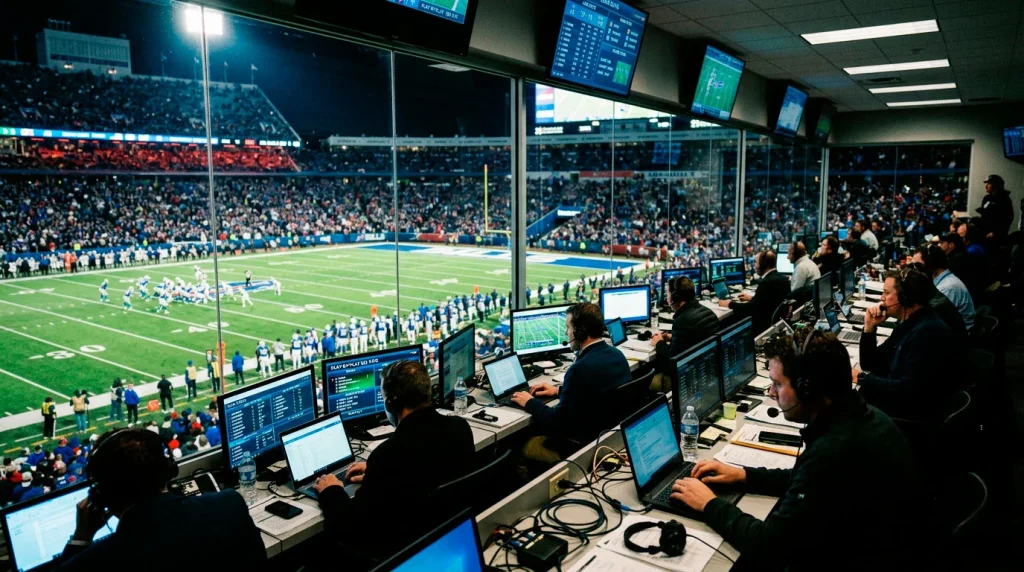
Every time you see an NFL live betting market update at your UK sportsbook – the spread shifting after a turnover, the total adjusting after a field goal, a player prop closing mid-drive – there is a data pipeline behind it that most bettors never think about. That pipeline starts at the stadium, runs through one of two companies, and arrives at your sportsbook’s odds engine in a fraction of a second. The speed, accuracy, and exclusivity of that data directly shape the prices you see and the markets available to you. The NFL generates $132 million annually in gambling-related sponsorship revenue, and a substantial portion of that figure flows from its official data partnerships.
See also UK sportsbook operator landscape for market context.
Contents
NFL Official Data: Sportradar and Genius Sports Roles
The NFL distributes its official real-time data through exclusive partnerships with Sportradar and Genius Sports. These two companies are the authorised conduits between what happens on the field and what appears on your betting screen. No UK sportsbook generates its own NFL play-by-play data independently – they all receive it through one of these providers, either directly or through sub-licensing arrangements.
Sportradar has been the NFL’s primary data distribution partner since 2015, holding the league’s official data rights for sports betting purposes. Their feed delivers play-by-play data, pre-snap information, game clock synchronisation, and statistical updates in near real time. The “near” qualifier matters – there is always a latency between a play occurring and the data reaching a sportsbook, typically measured in tenths of a second to low single-digit seconds. That latency is the invisible infrastructure that determines how quickly your in-play odds refresh.
Genius Sports operates in the NFL ecosystem through its broader sports data platform and has secured partnerships with various leagues globally. Their technology focuses on data capture, integrity monitoring, and the translation of raw game events into structured feeds that sportsbook pricing engines can consume. The distinction between Sportradar and Genius Sports at the NFL level is primarily one of licensing scope and commercial arrangement rather than fundamental technology difference – both deliver high-fidelity, low-latency data from NFL games to betting operators.
For UK sportsbooks, the practical effect is standardisation. Whether you bet at a large integrated operator or a smaller specialist bookmaker, the underlying NFL data powering your markets originates from the same official sources. The difference between operators is not what data they receive, but how their pricing algorithms interpret and respond to that data – which is where the competitive variation in odds and market depth originates.
How Data Feeds Affect the Odds You See
The journey from stadium to screen follows a consistent path. A play occurs. In-stadium data capturers – trained operators with specialised input devices – record the play type, yardage, personnel, and outcome. That data enters the official feed. The feed transmits to sportsbook odds engines. The odds engine recalculates probabilities based on the new game state. The updated odds appear on your screen.
In-play wagering accounts for over 62% of online sportsbook revenue, and the quality of that revenue depends entirely on the speed and accuracy of this pipeline. A sportsbook that receives data one second faster than a competitor can adjust its prices before the slower book reacts, reducing its exposure to informed bettors who exploit stale lines. From your perspective as a bettor, this latency race is invisible – but it explains why some live NFL betting platforms feel snappier than others and why certain operators suspend markets more frequently during fast-moving game situations.
The data feeds also determine which markets a sportsbook can offer in-play. Basic feeds support match result, handicap, and total points updates. Enhanced feeds include player-level statistics – passing yards accumulated, rushing attempts, receptions – which power live player prop markets. The most granular feeds track pre-snap formation data that some advanced operators use to price drive-result and next-play-type markets. The richer the data, the more markets the sportsbook can offer and the more accurately those markets are priced.
One variable that directly affects your betting experience is data interruption. If the official feed drops – due to technical failure, communication issues at the stadium, or provider-side outages – sportsbooks suspend all in-play markets until the feed resumes. These suspensions are brief (usually seconds to a few minutes), but they can occur at critical moments. A feed interruption during a goal-line stand or a two-minute drill means you cannot place in-play bets precisely when the action is most compelling. There is nothing any individual bettor can do about this – it is an infrastructure-level variable that affects all operators simultaneously.
Data Integrity and Match-Fixing Prevention
Official data partnerships serve a dual purpose: they power betting markets and they protect them. Both Sportradar and Genius Sports operate integrity monitoring divisions that analyse betting patterns across global markets in real time, flagging anomalies that could indicate match-fixing or corruption.
The NFL’s integrity programme uses data from its official partners to cross-reference unusual betting activity with on-field events. If a sportsbook reports a sudden, unexplained surge in volume on a specific prop market – say, the first-quarter total points in an otherwise unremarkable game – the integrity team investigates whether the betting pattern correlates with insider information or manipulated performance.
For UK bettors, this integrity infrastructure operates in the background and rarely surfaces in daily experience. Its existence matters because it underpins the credibility of the markets you wager on. A market without integrity monitoring is a market where you cannot trust the odds to reflect genuine probability. The official data partnerships provide that trust layer, even though most bettors never consciously think about it.
The integrity dimension also explains why sportsbooks are resistant to using unofficial data sources. Unlicensed data scrapers – services that capture broadcast video and extract play-by-play data without NFL authorisation – offer cheaper alternatives to official feeds. Some smaller operators have used these sources historically. The risk is twofold: the data may be less accurate or more latent than official feeds, and it exists outside the integrity monitoring framework. A sportsbook using unlicensed data cannot participate in the league’s coordinated integrity programme, which leaves both the operator and its customers more exposed to market manipulation.
See also nfl bet online for the complete NFL betting guide.
What This Means at Your End of the Screen
You do not choose your sportsbook’s data provider, and you cannot switch feeds mid-game. But understanding the data infrastructure gives you a practical advantage in three ways. First, it explains why in-play markets suspend at specific moments – it is not the sportsbook being cautious; it is the data feed catching up to the game state. Patience during suspensions is more productive than frustration.
Second, it frames the competitive landscape between sportsbooks. Operators with direct relationships with official data providers tend to offer wider in-play market menus and faster odds updates than those relying on sub-licensed feeds. If in-play NFL betting is central to your approach, the operator’s data infrastructure is a selection criterion worth investigating.
Third, it sets realistic expectations about speed. No UK sportsbook can offer truly instantaneous live odds because the data pipeline introduces inherent latency. If you see an NFL play result before your sportsbook adjusts its odds, that gap is measured in seconds and will close before you can reliably exploit it. Attempts to “beat the feed” by watching a broadcast that runs slightly ahead of the data stream are a strategy with diminishing returns as the pipeline gets faster each season.
