
NFL Parlay Betting UK: Accumulator Strategy and Odds Guide
 Available in US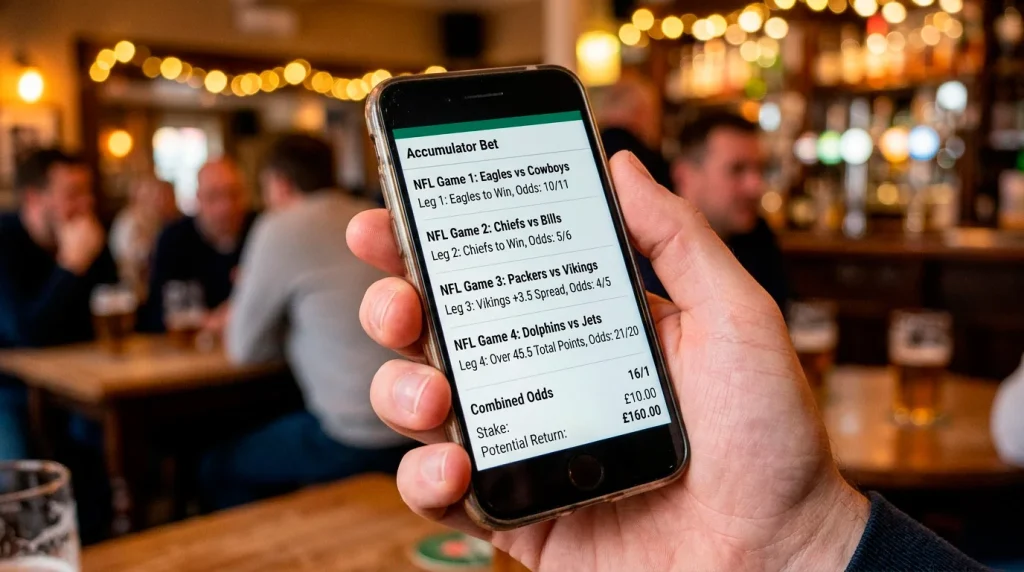
Four legs. All favourites. All covering. Three of them landed by halftime. The fourth lost on a meaningless last-minute field goal that turned a seven-point cover into a six-point miss. One leg. One field goal. The entire accumulator — dead. If that story sounds familiar, you have already been introduced to the cruel beauty of NFL parlay betting.
Parlays — or accumulators, as they are known at UK sportsbooks — combine multiple selections into a single bet. Every leg must win for the bet to pay. The appeal is obvious: the odds multiply with each added selection, turning modest stakes into potentially large returns. The risk is equally obvious: a single failure wipes out everything. The NFL’s status as the most heavily wagered league in the world means the parlay menu is deeper than any other sport, with hundreds of games across an 18-week regular season offering an enormous range of combinations. UK sportsbooks generate roughly £2.48 billion in annual sports betting gross gaming yield, and a meaningful slice of that comes from accumulator action on American football.
See also NFL acca tips for building winning parlays.
Contents
How NFL Parlays Work
A colleague once described parlays as “compound interest in reverse” — and I have not heard a better summary. Each selection you add multiplies the odds, but it also multiplies the probability of failure. The maths is straightforward but unforgiving.
Take three NFL games where you fancy the favourite on the moneyline, each priced at roughly 4/9 (implied probability around 69%). A single bet on any one of them has a reasonable chance of success. Combine all three into a parlay and the implied probability of all three winning drops to approximately 33% — meaning you need to hit this bet one in three times just to break even at the combined odds.
Add a fourth leg at the same price and the break-even probability drops to around 23%. A fifth drops it further to 16%. The escalation is relentless. By the time you are building six or seven-leg NFL accumulators — the kind that show up on social media with eye-catching potential payouts — the probability of success is typically below 10%.
UK sportsbooks calculate parlay odds by multiplying the decimal equivalents of each leg, then subtracting one to convert back to fractional. If your three legs are 1.44, 1.50, and 1.40 in decimal, the combined odds are 1.44 x 1.50 x 1.40 = 3.02 in decimal, or roughly 2/1 in fractional. That means a £10 stake returns £30.24 including the stake. The individual prices determine the combined payout — there is no separate “parlay bonus” built into the odds themselves, though some bookmakers offer acca boosts as promotional overlays.
One mechanical detail matters for NFL specifically: the settlement of individual legs. If one leg in your parlay is voided — because the game is postponed, or a spread lands exactly on the number (a “push” on whole-number spreads) — most UK sportsbooks will recalculate the parlay as if that leg did not exist, reducing the total odds but keeping the bet alive. This is standard practice, but worth confirming in your book’s settlement rules before the season starts.
The Maths Behind Parlay Odds
I spent an entire off-season tracking parlay results across a simulated 1,000-bet sample, varying the number of legs from two to eight. The results confirmed what the theory predicts: expected value on parlays is negative in almost every configuration, and it gets worse as legs increase.
The reason is margin stacking. Each individual selection carries a built-in bookmaker margin — the vig or overround. On a typical NFL spread bet, the overround might be 4-5%, meaning you are paying a small premium for each wager. In a single bet, that 4-5% is manageable. In a parlay, the margins compound. A four-leg parlay with 4.5% margin per leg carries an effective overround of roughly 19%. By the time you hit six legs, the effective house edge can exceed 30%.
This compounding is why professional bettors rarely use parlays as a core strategy. The exception is correlated parlays — combinations where the outcomes of the legs are statistically linked. For example, betting a team to win on the moneyline and the game total to go under are mildly correlated: if the favourite wins comfortably, the losing team’s offence often shuts down in the fourth quarter, suppressing the total. Some sportsbooks have closed this angle with same-game multi pricing that adjusts for correlation, but cross-game correlations — like backing two offence-heavy teams in different games to both go over their team totals — are harder for sportsbooks to model and occasionally produce positive expected value.
Acca Insurance and Acca Boosts for NFL
Walk into any UK sportsbook’s NFL section during the season and you will be offered some variation of “acca insurance” or “acca boost” — promotional overlays designed to make parlays more attractive. Understanding what these actually deliver, rather than what the marketing implies, is critical.
Acca insurance typically refunds your stake (as a free bet, not cash) if one leg of your accumulator loses and all others win. The conditions vary: minimum number of legs (usually four or five), minimum odds per leg (often 1/5 or 1/4), and the refund is almost always issued as a free bet with its own wagering restrictions. A free bet is worth less than cash — roughly 60-70% of face value, depending on the odds you use it on — so the insurance is not a full refund in real terms.
Acca boosts add a percentage to your potential winnings — 10%, 25%, sometimes more for longer accumulators. These are genuine value additions when the boost percentage exceeds the additional margin the sportsbook is extracting from the extra legs. On a four-leg NFL acca with a 10% boost, the boost roughly offsets one leg’s worth of margin. On a seven-leg acca with a 25% boost, the margin stack still overwhelms the boost. The maths matters more than the marketing.
I use acca insurance selectively: when I have four or five legs I genuinely like on their individual merits, the insurance turns a high-variance bet into a slightly less punishing one. I never add legs to qualify for an insurance threshold. Adding a leg you do not have a genuine edge on, just to access insurance, is paying more in expected margin than the insurance is worth. The core principles of bankroll management apply to parlays as much as they do to single bets — perhaps more so, given the variance involved.
See also nfl bet online for the complete NFL betting guide.
When the Accumulator Makes Sense
Parlays are not inherently bad bets. They are high-variance bets with negative expected value at the margins — which describes most recreational betting. The question is not whether you should ever use them, but how to use them without letting the variance dictate your season.
I allocate a fixed, small percentage of my weekly NFL budget — never more than 10% — to parlay action. The rest goes to single bets where I have a clear edge. That separation keeps the entertainment value of accumulators alive without contaminating the disciplined part of the operation. If the acca hits, it is a bonus. If it does not, the singles carry the week.
The configurations I favour are tight: two or three legs, each with a genuine analytical basis, each in a different game. I avoid mixing spreads and totals from the same game in a standard acca (that is what same-game multis are for, and they are priced differently). I avoid legs below 1/3 — the margin on very short-priced selections is proportionally higher, and one loss at those prices destroys the entire ticket for minimal return.
