
UKGC and NFL Betting: How UK Gambling Regulation Protects Punters
 Available in US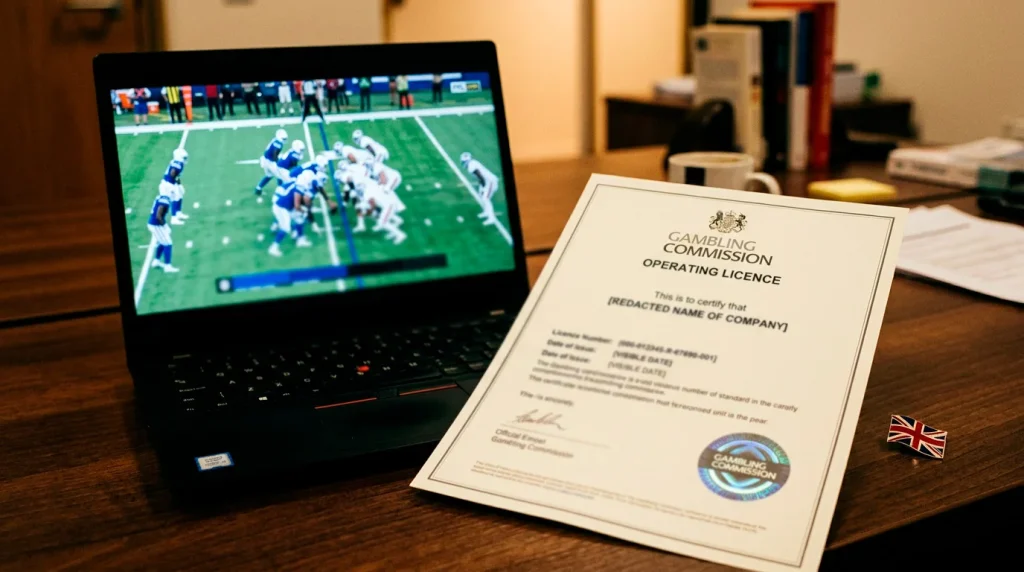
A punter I know lost access to his sportsbook account mid-season in 2026. No warning, no email, just a frozen balance and a locked login. It took him two weeks and a formal complaint to the UK Gambling Commission to get his funds released. The resolution was swift once the UKGC intervened — the operator had flagged his account incorrectly during an automated affordability check and failed to communicate. That story captures both the friction and the protection that UK regulation provides. The system is imperfect, but it works when you know how to use it.
The UK gambling industry generated £11.5 billion in gross gaming yield in the year to March 2026, making it one of the most heavily regulated betting markets on earth. Every sportsbook that accepts NFL wagers from UK residents operates under a licence issued by the Gambling Commission, and that licence comes with obligations that directly affect your experience as a bettor.
See also NFL responsible gambling under UKGC guidelines.
Contents
What the UKGC Does for NFL Bettors
The Gambling Commission is not a consumer advice bureau — it is a statutory regulator with enforcement powers. It issues and revokes operating licences, sets the conditions under which sportsbooks must operate, and investigates complaints that escalate beyond the operator’s internal dispute process. For NFL bettors specifically, this means every sportsbook offering American football markets to UK residents must hold a valid remote gambling licence, segregate customer funds from operational funds, and comply with anti-money-laundering and responsible gambling requirements.
The Remote Gaming Duty — the tax that online operators pay on their UK revenue — rose from 21% to 40% for casino products in April 2026. While this rate increase applies to online casino rather than sports betting directly, it signals the government’s willingness to increase the fiscal burden on operators. The General Betting Duty for remote sports betting is set to rise from 15% to 25% in April 2027, and that change will affect the economics of NFL betting directly — potentially tightening margins on promotional offers and odds competitiveness.
Licence conditions are not theoretical. The Gambling Commission issued over £30 million in regulatory penalties between 2023 and 2026, targeting operators who failed to implement adequate source-of-funds checks, responsible gambling interventions, or marketing compliance. When an operator loses its licence or faces restrictions, customers’ funds are protected under the ring-fencing requirements — your balance does not vanish with the operator’s compliance failure.
Key Player Protections Under UK Gambling Law
Baroness Twycross, the UK’s gambling minister, framed the regulatory agenda as wanting “to see a safer, more responsible gambling industry” while acknowledging that most people gamble without harm. That balance — protection without prohibition — shapes the specific safeguards available to every NFL bettor at a UKGC-licensed sportsbook.
Deposit limits are mandatory. Every licensed sportsbook must allow you to set daily, weekly, or monthly deposit caps. Once set, a limit cannot be increased immediately — there is a mandatory cooling-off period (typically 24 hours) before any increase takes effect. Decreases apply instantly. This asymmetry is deliberate. It makes impulsive escalation harder while keeping restraint frictionless.
Reality checks interrupt your session at intervals you define — every 30 minutes, every hour, or every two hours. A pop-up appears showing how long you have been active and your net position (deposits minus withdrawals plus or minus bet outcomes). These are easy to dismiss, and I will not pretend they transform behaviour on their own. But for bettors who set them as part of a broader discipline framework, they serve as a checkpoint — a moment to ask whether the next bet is strategic or reactive.
Self-exclusion through GamStop covers all UKGC-licensed operators simultaneously. Once you register, every licensed sportsbook in the UK must close your account and refuse to open a new one for the duration of your exclusion period (six months, one year, or five years). There is no partial exclusion — you cannot block NFL betting while keeping football or horse racing active. GamStop is binary, comprehensive, and designed for situations where individual operator controls are not sufficient.
Complaint resolution follows a structured path. Internal complaint first, with the operator required to respond within eight weeks. If unresolved, the complaint escalates to an Alternative Dispute Resolution (ADR) provider approved by the Gambling Commission. The ADR decision is binding on the operator, not on you — if you disagree, you retain the right to pursue the matter further. Most NFL-related disputes I have seen involve delayed withdrawals, voided bets due to alleged terms violations, or affordability check disputes.
How to Resolve Disputes with Your NFL Sportsbook
The formal process is straightforward, but the practical execution has nuances that most guides skip. When filing a complaint, specificity is everything. “My withdrawal was delayed” is weaker than “I requested a withdrawal of £340 on 14 October, received confirmation email reference XYZ-456, was told processing would take 3-5 business days, and the funds had not arrived by 22 October despite two follow-up contacts.” The second version gives the ADR provider a timeline and evidence trail. The first gives them a feeling.
Document everything from the moment a dispute begins. Screenshot the bet slip, the terms and conditions page, any chat or email correspondence, and the relevant pages of the operator’s rules. Operators occasionally update their terms mid-season, and if a dispute hinges on which version of the terms applied at the time of your bet, a timestamped screenshot is your best evidence.
The Gambling Commission itself does not adjudicate individual disputes — that is the ADR provider’s role. What the Commission does is track complaint volumes and patterns by operator. An operator that accumulates excessive complaints faces licence review, additional conditions, or fines. Your complaint, even if small in monetary terms, contributes to that regulatory pressure. Filing it is not just about your £50 — it is about the systemic accountability that makes UK regulation function.
See also nfl bet online for the complete NFL betting guide.
The Licence Check That Takes Thirty Seconds
Before depositing a single pound with any sportsbook for NFL betting, verify their licence status on the Gambling Commission’s public register. The register is searchable by operator name and shows the licence type, current status, any regulatory actions, and the date of last review. An active licence with no recent enforcement actions is the minimum threshold. An operator with a suspended licence or pending investigation is one to avoid entirely, regardless of how attractive their NFL welcome offer appears.
The register also distinguishes between operators that hold their own licence and those operating under a third party’s licence (known as “white label” arrangements). White-label operators are legal, but the regulatory accountability chain is longer — if something goes wrong, the licence holder (not the brand you interact with) is the entity the Commission regulates. This distinction matters when disputes escalate.
