
NFL Prop Bets UK: Player Props, Game Props & Touchdown Markets
 Available in US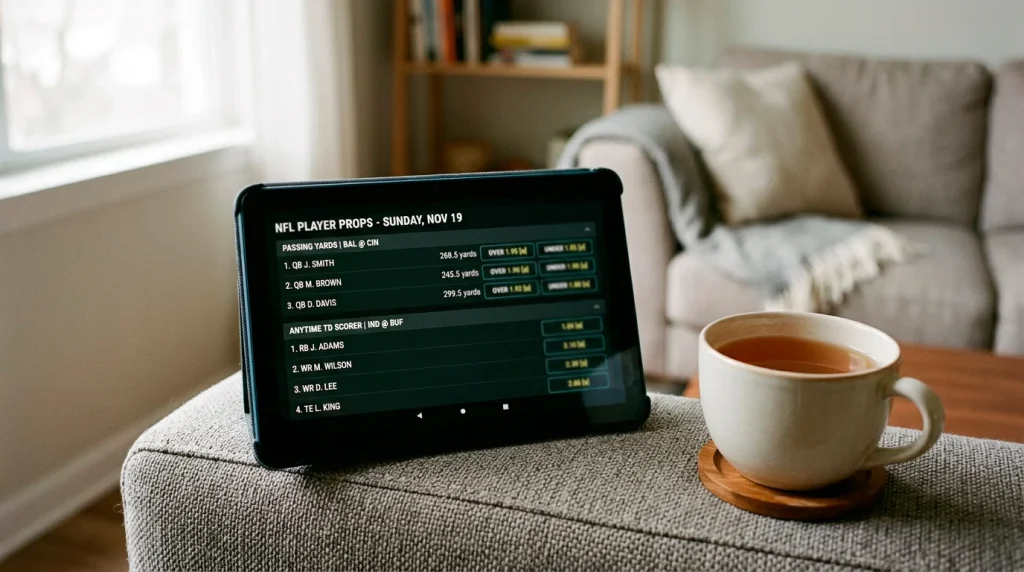
The game was settled by halftime — a 28-3 blowout that made the moneyline and spread bets irrelevant before the third quarter even started. But I was still watching, still engaged, because I had a player prop on the losing team’s running back to go over 67.5 rushing yards. He finished with 74. That is the pull of prop betting: it turns every snap into a separate contest, independent of which team actually wins.
Prop bets are the fastest-growing segment of NFL wagering, and it is not hard to see why. The NFL now generates $132 million annually from gambling-related sponsorship deals — up from $35 million in 2018 — and a huge portion of that growth is driven by prop market expansion. For UK punters, props offer a way to bet on individual performances and specific game events without needing to predict the final score or margin. They reward knowledge of players, schemes, and matchups rather than just team-level analysis.
See also NFL betting markets explained for the full picture.
Contents
Player Props: Passing Yards, Rushing, and Touchdowns
When I first started tracking prop markets seriously, the available options at UK sportsbooks were thin — quarterback passing yards, maybe a touchdown scorer market, and that was it. Today, a marquee NFL game might offer 300-plus individual prop markets. The explosion has been extraordinary, and it has shifted where I spend most of my research time.
Player props set a line on an individual’s statistical output. A quarterback might be listed at over/under 264.5 passing yards. A running back at over/under 72.5 rushing yards. A wide receiver at over/under 5.5 receptions. Your job is to assess whether the player will exceed or fall short of that line. The sportsbook sets the number based on season averages, opponent defensive rankings, and recent form — but those inputs are backward-looking, which creates opportunity.
Touchdown scorer markets are the most popular player prop at UK books, and for good reason — they are easy to understand and carry attractive odds. An anytime touchdown scorer bet pays if your selected player scores at any point during the game. First touchdown scorer markets pay more but are significantly harder to hit, since you are predicting both the scorer and the sequence. I treat first touchdown bets as entertainment rather than strategy; anytime touchdowns are where the analytical edge lives.
The research advantage in player props comes from matchup specificity. A running back’s season average of 65 rushing yards per game tells you very little about what he will do against a specific defence. If that defence ranks 30th against the run and has just lost their starting nose tackle to injury, the over on 62.5 looks very different from the season average alone. I cross-reference three data points for every player prop I consider: the player’s last four performances, the opposing defence’s position-specific ranking, and the game script projection — will this team be running the ball in the second half, or will they be chasing a deficit through the air?
Passing yard props deserve special attention because they are directly tied to game flow. A quarterback facing a weak defence in a game with a high total (50+) is likely to accumulate volume. The same quarterback against a strong defence in a low-total game (under 40) is likely to be suppressed. The over/under on the game total is, in effect, a meta-signal for passing yard props.
Game Props: Total Sacks, Turnovers, and First Score
Not every prop revolves around a single player. Game props focus on events that involve both teams collectively — total sacks in the game, total turnovers, whether the first score will be a touchdown or a field goal, which team scores first, and whether the game goes to overtime.
Live in-play wagering accounts for over 62% of online sportsbook revenue, and game props are a major driver of that figure. Markets like “next team to score” and “next scoring method” refresh constantly during the broadcast, creating a rolling menu of micro-bets throughout the game. I find game props most useful as hedging tools — if my pre-match spread bet is at risk, a well-timed “next team to score” wager on the opposing side can reduce exposure without cashing out at a penalty.
Total sacks is a game prop I track closely because it is one of the few where the market consistently underweights one variable: offensive line injuries. A team missing their starting left tackle might not see their moneyline move much, but the total sacks line should shift — and it often does not move enough. Sack rates are heavily influenced by pass protection quality, and that quality can change dramatically with a single personnel change.
First score method props — touchdown, field goal, or safety — reward an understanding of how games typically start. Across the league, roughly 55-60% of first scores are touchdowns and 35-40% are field goals, with safeties sitting below 1%. The odds at UK sportsbooks usually price touchdowns at around 4/7 and field goals at 6/4. Neither price offers significant value in isolation, but when you layer in team-specific tendencies — some offences stall in the red zone at far higher rates early in games — the field goal first score can move into value territory.
Researching Prop Bets: Where to Find an Edge
Bill Miller, the AGA’s president, described the current legal betting landscape as having delivered “exceptional results for consumers, operators, and the communities we serve” — and prop markets are a direct beneficiary of that expansion. More data, more markets, and more competition between sportsbooks all work in the bettor’s favour. But data abundance is not the same as data quality, and the edge in props comes from knowing which numbers matter.
I build my prop research around three sources. First, weekly snap-count reports. A player who saw 85% of offensive snaps last week is in a fundamentally different opportunity tier than one who saw 55%. Snap count directly correlates with statistical volume — more snaps mean more chances to accumulate yards, receptions, and touchdowns. When a player’s snap share is trending up due to a teammate’s injury or a scheme change, the prop lines often lag that trend by a week.
Second, Super Bowl and playoff matchup data. Postseason games, especially the Super Bowl, generate the highest volume of prop action by far. Sportsbooks respond by tightening their lines on mainstream markets but often leave exotic player props — second-half receiving yards, fourth-quarter rushing attempts — with softer numbers because the modelling is harder and the action is lighter.
Third, weather forecasts for outdoor games. Wind above 15 mph suppresses passing volume. Rain increases fumble risk. Extreme cold affects kicking accuracy. These environmental factors shift the probability distribution on player props in ways that the standard statistical models underweight. A quarterback’s passing yard over/under might be set at 275.5 based on his indoor numbers, but if the game is outdoors in 20 mph gusts, the under is a different bet entirely.
The trap in prop betting is volume. Because there are hundreds of markets per game, it is tempting to scatter small stakes across a dozen picks. Resist that impulse. I rarely take more than three prop positions on a single game, and each one has a documented reasoning. Quality over quantity applies nowhere more forcefully than in props.
See also nfl bet online for the complete NFL betting guide.
The Prop Market’s Blind Spot
Prop markets are priced by algorithms that rely on historical data, and historical data has a fundamental limitation: it describes what happened, not what is about to happen. Coaching changes, scheme adjustments mid-season, and in-game adaptations all create gaps between what the algorithm expects and what the game produces. Those gaps are where disciplined prop bettors operate.
I keep a running list of “narrative mismatches” — games where the public story (a team is struggling, a quarterback is in a slump) diverges from the underlying data (snap counts are stable, target share is increasing, the schedule is about to soften). Prop lines absorb narrative quickly because casual bettors react to headlines. When the narrative is wrong but the data is right, the prop prices lag reality, and that is where the profit sits.
