
NFL Handicap Betting: Asian Handicap and Alternative Lines for UK Punters
 Available in US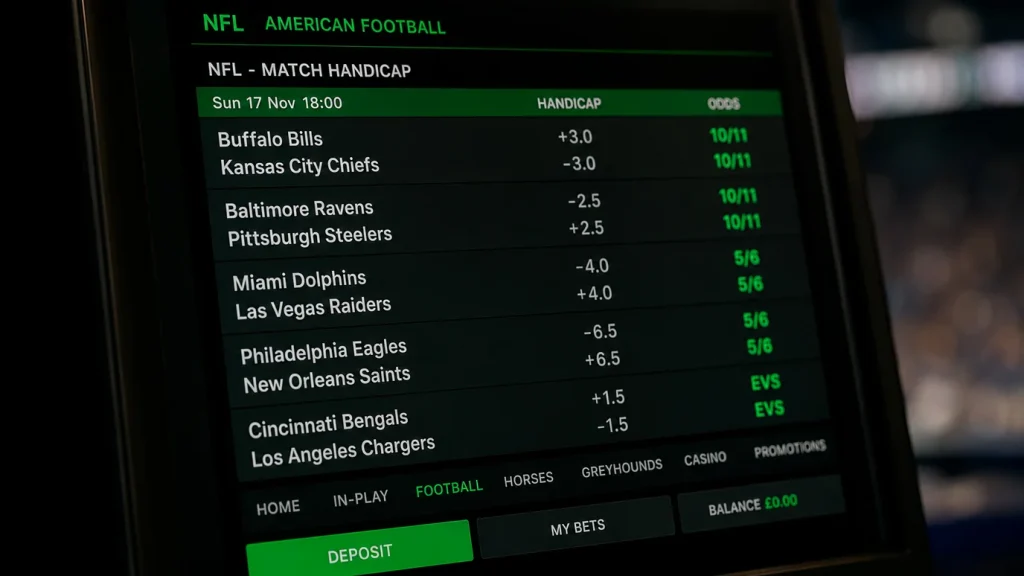
The first time a UK punter encounters the term “handicap” in an NFL context, there is a moment of recognition followed by confusion. The concept is familiar – football fans have seen Asian handicap markets on Premier League games for years. But the application to American football introduces wrinkles that do not exist in soccer: different key numbers, different push rules, and a structural relationship to the “point spread” that most American bettors take for granted but UK punters need explained from scratch.
The NFL is the most heavily wagered league in the world, with a single Sunday afternoon generating more handle than a full week of MLB or NBA combined. Handicap markets absorb a significant share of that volume because they address the fundamental challenge of every NFL betting menu – the vast majority of games feature a clear favourite, and the moneyline on that favourite rarely offers enough value to justify the risk.
See also NFL over/under explained as a related market.
Contents
Standard Handicap Lines for NFL
A standard NFL handicap works identically to a point spread. The sportsbook assigns a positive number to the underdog and a negative number to the favourite. If the Kansas City Chiefs are -6.5 against the Denver Broncos (+6.5), the Chiefs must win by 7 or more for a Chiefs handicap bet to win. If the Broncos lose by 6 or fewer – or win outright – a Broncos handicap bet wins.
The half-point (.5) in NFL handicaps eliminates the possibility of a push, which is the scenario where the margin of victory lands exactly on the handicap number and the bet is voided (stake returned). UK sportsbooks overwhelmingly default to half-point handicaps for this reason – it produces a definitive result on every bet, simplifying settlement and reducing customer confusion.
Where NFL handicap betting diverges from football handicaps is in the key numbers. In soccer, goals are scored in increments of one, and handicap lines cluster around 0, -0.5, -1, -1.5, and -2. In American football, scoring increments of 3 (field goal) and 7 (touchdown plus extra point) create specific margins that occur far more frequently than others. The numbers 3 and 7 are the most common margins of victory in NFL history. A handicap line of -3.5 is therefore fundamentally different from -2.5 – crossing the 3 threshold means your bet needs the favourite to win by more than the single most common winning margin. That distinction does not exist in soccer handicaps, and understanding it is essential for NFL handicap betting in the UK.
The UK sports betting market generates approximately £2.48 billion in gross gaming yield each year, and handicap markets are a core revenue driver because they attract volume on both sides of the line – a well-set handicap should generate roughly equal action on favourite and underdog, allowing the sportsbook to profit from the margin regardless of the outcome.
Asian Handicap in NFL: Split Lines and No Draw
Asian handicap markets in NFL are less common at UK sportsbooks than their football equivalents, but they exist at several operators – particularly those with heritage in Asian betting markets. The mechanics transfer cleanly to American football with one simplification: NFL games cannot end in a draw during the regular season (overtime rules produce a winner), which removes the draw-no-bet component that complicates Asian handicaps in soccer.
A quarter-line Asian handicap – for example, Chiefs -6.25 – splits your stake between two adjacent lines: half on -6 and half on -6.5. If the Chiefs win by exactly 6, you win half your bet (the -6 leg pushes, the -6.5 leg loses – but the push returns your stake on that half, so you lose only 50% of your total position). If the Chiefs win by 7 or more, both halves win. If the Chiefs win by 5 or fewer, both halves lose.
The appeal of quarter-line handicaps is that they reduce the risk of a total loss on close results. Instead of losing your entire stake when the margin lands on the wrong side of a half-point line, you lose half. The trade-off is that quarter-line odds are adjusted to reflect this reduced risk – the prices are marginally shorter than on a standard half-point handicap. Whether the risk reduction justifies the price reduction depends on how you value variance management. For bettors who stake consistently and want smoother returns, quarter-line handicaps offer a structural advantage. For bettors focused on maximising expected value per bet, the standard half-point line at better odds is preferable.
See also nfl bet online for the complete NFL betting guide.
Alternative Handicap Markets: Bigger Spreads, Different Odds
Alternative handicaps allow you to bet on a team at a larger or smaller spread than the main line, with the odds adjusting accordingly. If the main handicap is Chiefs -6.5 at 10/11, the alternative menu might offer Chiefs -3.5 at 4/9, Chiefs -10.5 at 6/4, Broncos +3.5 at 7/4, and Broncos +10.5 at 2/7.
The logic is straightforward: a smaller handicap (closer to zero) is easier for the favourite to cover, so the odds are shorter. A larger handicap is harder to cover, so the odds are longer. Alternative handicaps let you calibrate your position to match your conviction. If you believe the Chiefs will win comfortably but the -6.5 main line feels like a coin flip, taking -3.5 at shorter odds reduces the variance while still expressing a directional view.
I use alternative handicaps most frequently in accumulator construction. A four-leg acca built from four standard handicaps at 10/11 each pays around 14/1. The same four games with alternative handicaps of -3.5 (instead of -6.5, -7, etc.) at 4/9 to 1/2 each produces a much shorter overall price but a significantly higher probability of success. Whether the shorter price justifies the safer selection depends on your acca philosophy – but having the option to adjust individual legs’ risk profiles is a genuine advantage that alternative handicaps provide.
One caution: alternative handicap margins are wider than main-line margins at most UK sportsbooks. The main handicap line is the most liquid and competitively priced market. As you move to alternatives, the sportsbook has less balancing volume and prices accordingly. The further from the main line you go, the wider the margin embedded in the odds. Checking prices across multiple operators is more important on alternative handicaps than on any other NFL market because the margin variance between sportsbooks can exceed 5% on extreme alternatives.
