
NFL Cash Out Betting: When to Lock In Profit and When to Hold
 Available in US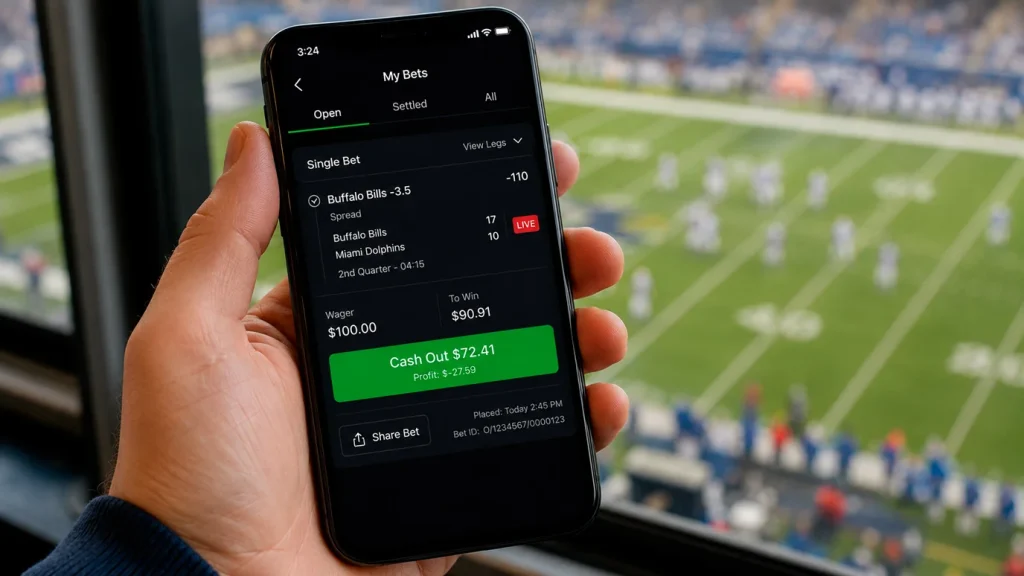
Third quarter, Week 8. I had a three-leg NFL accumulator that needed one more result to pay out at 22/1. The cash out offer sat at £186 against my original £10 stake. My remaining leg — the Dolphins to cover -3.5 — looked solid with Miami leading by 10. I stared at the green button for ninety seconds and tapped “Hold.” Miami won by 17, the acca landed, and I collected £230. The £44 difference between cashing out and holding is not the point. The point is that I spent ninety seconds making a decision that should have taken five, because the cash out button is designed to create urgency, not to help you think clearly.
Cash out is one of the most used features in modern sports betting. In-play wagering accounts for over 62% of online sportsbook revenue, and cash out is the mechanism that converts in-play anxiety into completed transactions. Understanding how the offer is calculated — and when accepting it makes mathematical sense — separates strategic use from emotional surrender.
See also NFL betting apps with cash out features.
Contents
How Bookmakers Calculate Your NFL Cash Out Offer
The cash out value is not a gift. It is a calculation. The sportsbook takes the current implied probability of your remaining selections winning, multiplies it by your potential payout, and then applies a margin deduction. That margin is the operator’s profit on the cash out transaction, and it typically ranges from 3% to 8% depending on the operator, the market, and the timing.
For a simple NFL moneyline bet, the calculation is relatively transparent. If you backed a team at 2/1 (implied probability 33%) and they are now leading with ten minutes remaining, the live probability might be 85%. Your potential payout on a £10 bet is £30. The fair cash out value is 85% of £30 = £25.50. The sportsbook offers you £23-24, keeping the difference. That £1.50-2.50 gap is the cost of certainty.
For accumulators, the calculation compounds. Each unsettled leg has its own live probability, and the cash out reflects the product of all remaining probabilities, minus the margin. A four-leg acca with two legs settled and two remaining is priced on the combined probability of those two open legs. The margin on accumulator cash outs tends to be wider than on singles because the operator is pricing multiple sources of uncertainty simultaneously.
What 95% of bettors do not realise is that the cash out margin is not fixed. It varies by operator, by sport, and by time of day. During peak NFL action — Sunday afternoon, prime-time games — the cash out margin can widen because the operator is managing concentrated risk across thousands of simultaneous positions. On a quiet Thursday night game, the margin is often tighter. If you are a regular user of cash out, tracking these patterns across your preferred sportsbooks gives you a genuine informational advantage.
Partial Cash Out and Auto Cash Out for NFL Bets
Full cash out is binary: you take the offer and your bet closes. Partial cash out splits the decision. You can cash out a percentage of your position — say 50% — and leave the remaining 50% to ride. If your £10 acca at 22/1 has a cash out offer of £150, a 50% partial cash out gives you £75 guaranteed while leaving a £5-equivalent position running at the original odds.
I use partial cash out more than full cash out, and the reason is purely mathematical. In the scenario above, taking £75 off the table means I have already locked in a 7.5x return on my original stake. The remaining position is now playing with house money — if it loses, I am still profitable. If it wins, I collect the remainder. This is the textbook application of partial cash out: securing a baseline return while maintaining upside exposure.
Auto cash out is less widely available but increasingly useful. You set a target cash out value — “cash out my bet automatically if the offer reaches £200” — and the sportsbook executes when the threshold is hit. This removes the emotional component entirely. I set auto cash out targets on NFL futures bets, where the cash out value fluctuates over weeks and months. A Super Bowl futures bet placed in August might hit an auto cash out trigger in November if the team starts the season strongly, without me needing to monitor the market daily.
The limitation of auto cash out is latency. During live NFL games, the cash out value can change rapidly — a touchdown shifts the calculation instantly. If your auto cash out target is £200 and the offer hits £201 for six seconds before dropping back to £180, the system may or may not execute depending on the operator’s refresh rate and your connectivity. Auto cash out works best for pre-match and futures positions where the movement is gradual, not for real-time in-play situations where milliseconds matter.
See also nfl bet online for the complete NFL betting guide.
When Cashing Out NFL Bets Makes Sense — and When It Does Not
Bill Miller, president of the American Gaming Association, encouraged bettors to “have a game plan before placing a bet” — and that game plan should include a pre-determined cash out policy. Deciding whether to cash out in the moment, with the green button pulsing on your screen and the game clock ticking, is the worst possible time to make a financial decision. The decision should already be made.
Cash out makes sense in three scenarios. First, when new information fundamentally changes your assessment. You backed the 49ers -3.5, and their starting quarterback gets injured in the first quarter. The spread has shifted to pick ’em. Your pre-game thesis is broken, and cashing out at a reduced loss is better than holding a position you no longer believe in.
Second, when the cash out value exceeds your pre-set target. Before placing the bet, I define a cash out threshold — typically 70% of the potential full payout. If my bet could pay £100 and the cash out reaches £70, I take it. The remaining 30% is the cost of avoiding the variance. This rule is rigid. I do not renegotiate with myself in the moment.
Third, when the opportunity cost justifies it. If cashing out a futures bet for £300 profit frees up capital that you can redeploy into weekly NFL bets with a higher expected return, the redeployment value might exceed the expected value of holding the futures position. This is an advanced calculation, but it applies to bettors who manage a structured bankroll across multiple NFL markets.
Cash out does not make sense when the only motivation is anxiety. The sportsbook’s user interface is designed to make the cash out button prominent, pulsing, and psychologically urgent. That urgency is a feature for the operator, not for you. Every cash out you accept at a margin penalty transfers value from your account to the sportsbook’s bottom line. The only way to win that exchange is to cash out less often than the interface encourages you to — and only when the mathematical case is clear.
