
NFL Odds Formats: Fractional vs American vs Decimal Explained
 Available in US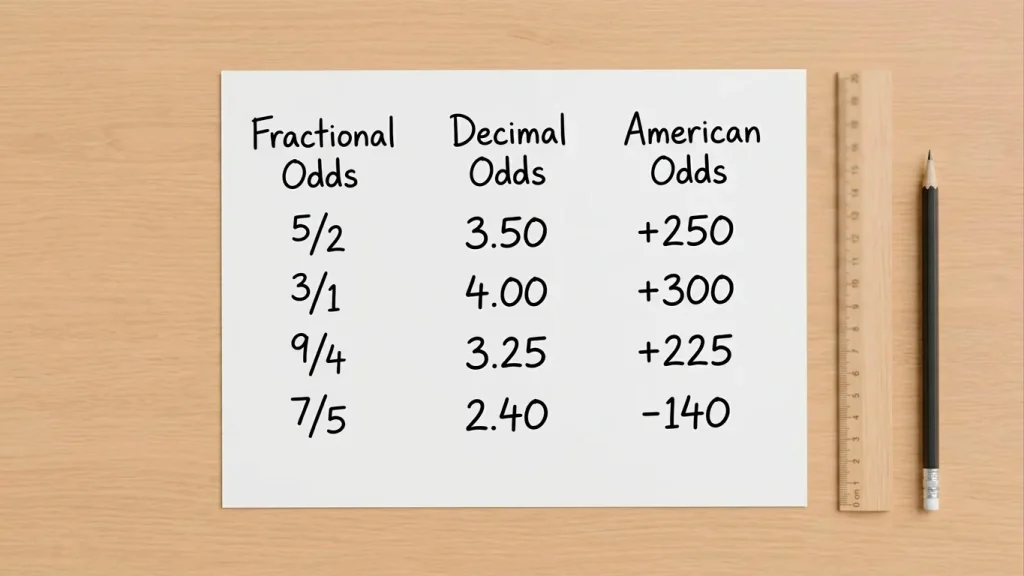
The first time I read an NFL preview from a US analyst, the line said “Chiefs -150, Broncos +130.” I stared at it for a solid minute. Negative numbers? Plus signs? In the UK, odds are fractions — 2/1, 5/4, 8/15 — and they have been for as long as bookmaking has existed. But if you want to follow NFL analysis from American sources, and you should, you need to speak both languages fluently.
The UK accounts for roughly 3% of global NFL search traffic, which means the vast majority of NFL betting analysis is produced for an American audience using American odds. Learning to read and convert between formats is not optional for any UK punter serious about NFL wagering — it is the entry ticket to the best research available.
See also NFL betting glossary for key odds terminology.
Contents
The Three Odds Formats: How Each One Works
Around 10% of UK adults participate in online sports betting, and virtually all of them encountered fractional odds first. So let me start there, on familiar ground, then bridge outward.
Fractional odds express profit relative to stake. A price of 3/1 means £3 profit for every £1 you risk, plus your stake back — so a £10 bet at 3/1 returns £40 total (£30 profit + £10 stake). A price of 1/3 is the inverse: you risk £3 to win £1, so a £30 bet at 1/3 returns £40 total (£10 profit + £30 stake). The left number is your potential profit; the right number is what you need to stake to earn it. UK punters read fractional odds instinctively because they grew up with them at the bookies and on Sky Sports.
Decimal odds are the simplest format mathematically. The number represents the total return per unit staked, including the stake. Decimal 4.00 means a £1 bet returns £4 (£3 profit + £1 stake) — identical to fractional 3/1. Decimal 1.33 means a £1 bet returns £1.33 (£0.33 profit + £1 stake) — identical to fractional 1/3. To convert fractional to decimal: divide the left by the right, then add one. 3/1 = (3 / 1) + 1 = 4.00. 5/4 = (5 / 4) + 1 = 2.25. European sportsbooks default to decimal, and most UK betting apps let you toggle between fractional and decimal in settings.
American odds — also called moneyline odds, confusingly — use positive and negative numbers. Positive odds tell you how much profit you make on a £100 stake. +130 means £130 profit on a £100 bet (total return £230). Negative odds tell you how much you need to stake to win £100 profit. -150 means you stake £150 to win £100 (total return £250). The minus sign indicates the favourite; the plus sign indicates the underdog. This format is universal in US sports media, which is why every NFL preview you read from an American source uses it.
The system feels backwards to UK-trained eyes because it anchors on £100 rather than on a single unit. Once you reframe it — negative means “how much do I risk to win a hundred,” positive means “how much do I win if I risk a hundred” — the logic clicks. But the conversion is where the practical skill lives.
Converting Between Odds Formats: Step by Step
I keep a conversion cheat sheet pinned to my desk during the NFL season. After twelve years, the common prices are second nature, but odd numbers still trip me up. Here is the method I use.
American to decimal is the conversion you will need most often, since you are translating US analysis into the format your UK sportsbook uses. For positive American odds: divide by 100, add 1. So +130 becomes (130 / 100) + 1 = 2.30 decimal. For negative American odds: divide 100 by the absolute value, add 1. So -150 becomes (100 / 150) + 1 = 1.667 decimal.
Decimal to fractional is the next step if your book displays fractional. Take the decimal, subtract 1, then express as a fraction. Decimal 2.30 minus 1 = 1.30, which is 13/10 fractional. Decimal 1.667 minus 1 = 0.667, which is 2/3 fractional (or more precisely, 667/1000, but sportsbooks round to standard fractions). Common NFL prices and their equivalents across all three formats:
A heavy favourite at -300 American = 1.33 decimal = 1/3 fractional. A moderate favourite at -150 = 1.67 = 4/6. An even-money shot at +100 = 2.00 = evens (1/1). A short underdog at +150 = 2.50 = 6/4. A longer underdog at +300 = 4.00 = 3/1. Memorise that table and you can read any NFL preview published anywhere in the world.
Implied probability is the conversion that actually matters for betting decisions. It strips away the format entirely and tells you what the odds are really saying about the likelihood of each outcome. For decimal odds: implied probability = 1 / decimal odds x 100. Decimal 2.50 = 1 / 2.50 x 100 = 40%. For American odds: positive — divide 100 by (the American odds + 100) x 100, so +150 = 100 / 250 x 100 = 40%. Negative — divide the absolute value by (the absolute value + 100) x 100, so -200 = 200 / 300 x 100 = 66.7%. Once you are thinking in implied probabilities rather than raw odds, the format on the screen becomes irrelevant — you are comparing your assessment of probability against the market’s assessment, which is the essence of value betting.
Which Odds Format Should UK NFL Bettors Use?
Michael Dugher, the CEO of the Betting and Gaming Council, has spoken about the 22.5 million people in the UK who bet regularly — and the overwhelming majority of them use fractional odds because that is what UK sportsbooks default to. But for NFL betting specifically, I recommend switching your app to decimal.
The reason is mathematical practicality. Decimal odds make parlay calculations, implied probability comparisons, and cross-sportsbook price checks significantly faster than fractional. Multiplying 2.30 x 1.85 x 2.10 for a three-leg acca takes seconds. Doing the same with 13/10 x 17/20 x 11/10 requires converting to decimals first anyway. Most UK apps let you toggle the display in settings — one tap, and every price on the screen shifts to decimal.
For consuming US analysis, learn to read American odds without converting. The more NFL content you absorb in its original format, the faster your fluency develops. Within a season of regular reading, -110 and +150 will feel as natural as 10/11 and 6/4. The friction disappears with repetition.
One practical note: when comparing odds across moneyline markets at different UK books, always compare in the same format. A price of 5/4 at one book and 2.30 at another look different but are functionally identical (5/4 = 2.25, so the 2.30 book is offering marginally better value). Mixing formats during comparison is where conversion errors creep in, and conversion errors cost real money.
See also nfl bet online for the complete NFL betting guide.
The Language Beneath the Numbers
Odds formats are just languages describing the same reality. The underlying truth — the market’s assessment of probability — does not change because you read it in fractional, decimal, or American. What changes is your ability to process that information quickly and accurately.
Master the conversions, switch your app to the format that makes calculation easiest, and then forget about format entirely. The real skill in NFL betting is not reading the odds — it is determining when the odds are wrong. Every minute spent fumbling with conversion is a minute not spent on the analysis that actually generates an edge.
